
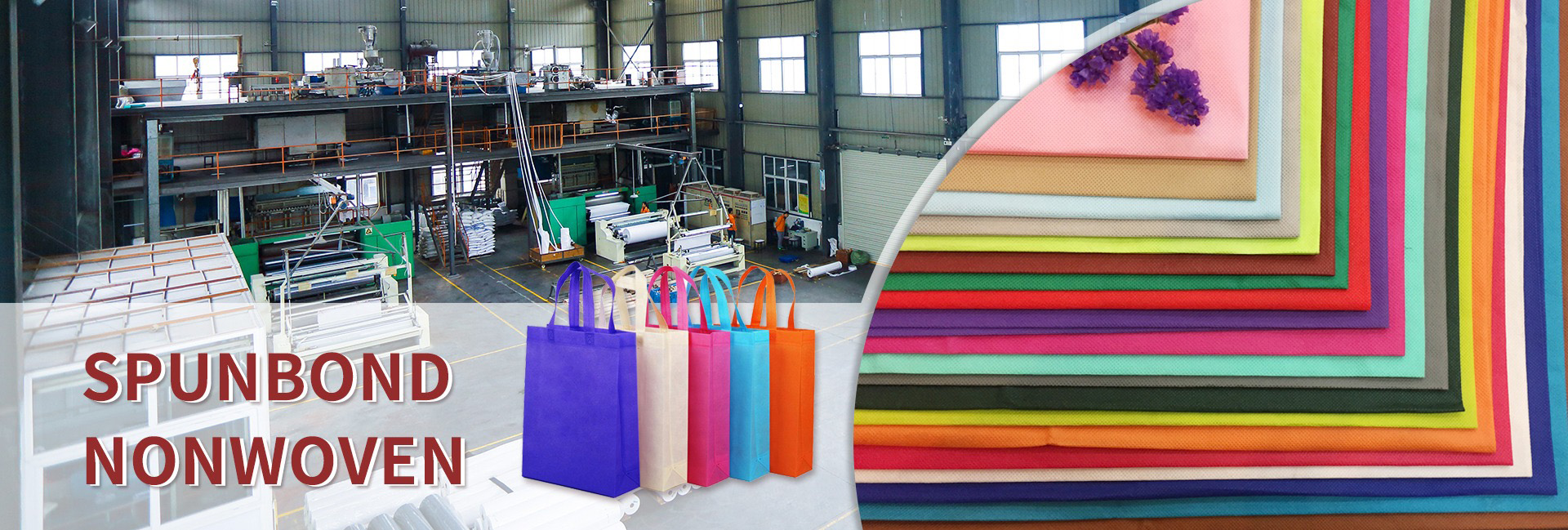
From the insulation “two curtains” in the greenhouse, to the “protective clothing” worn on fruits in the orchard, to the seedling bags used to “root train” young saplings in the nursery – it may be hard to imagine that these agricultural materials with different shapes and functions all come from the same “cloth”.
It is PP non-woven fabric.
We have previously talked about its ability to help strawberries and vegetables enter the market in advance, as well as its miraculous skills in “subduing” weeds in orchards. Today, let’s take a panoramic scan to see what unexpected application scenarios this seemingly ordinary “cloth” has.
After reading it, you will find that PP spunbond non-woven fabric is no longer the “exclusive supporting role” of masks and wipes, but an omnipotent “versatile player” in modern agriculture.
‘Breathing Cradle’: Nursery bags, allowing seedlings to win at the starting line
Let’s talk about seedling cultivation first. Traditional plastic seedling containers have a fatal flaw: they are not breathable. After the root system grows to the wall of the container and has no way out, it begins to spiral and entangle at the bottom, forming “nest roots” and “coiled roots”, and eventually growing into a poorly developed “little old man tree”.
The emergence of PP non-woven seedling bags has perfectly solved this problem.
Its principle is very clever: the special structure formed by PP fiber weaving has excellent breathability. After the plant roots come into contact with the bag wall, they will naturally stop elongating due to the “root cutting effect” of air, and sprout a large number of capillary roots and fibrous roots inside the bag.
In this way, the root system of seedlings not only does not tangle or knot, but also extends freely like in a field, forming a developed fibrous root system.
What’s even more reassuring for growers is that this seedling bag can be transplanted directly without removing the bag. It will naturally degrade in the soil, without any recycling process, and also avoids the “white pollution” of traditional plastic seedling containers.
According to research calculations, trees transplanted using non-woven seedling containers can achieve a root retention rate of over 80%, effectively reducing damage and shortening the recovery period.
Harvest cloth, insulation and insect prevention to promote a bountiful harvest
Let’s talk about ‘Harvest Cloth‘ again – this nickname itself fulfills its mission.
Harvest cloth is the most classic application of PP non-woven fabric in the field of agricultural coverage. It can directly “float” on crops, playing multiple roles such as insulation, frost prevention, and insect prevention.
In the low temperature season of winter and spring, the harvest cloth can effectively increase the ground temperature and temperature, allowing vegetables to be sold earlier. Cabbage growers in Nantong, Jiangsu have utilized floating surface covering technology to advance the planting period to the end of January, and the market launch period is about 15 days earlier than usual, resulting in an increase in income of over 1500 yuan per mu.
What’s even more impressive is that the fiber mesh of PP non-woven fabric itself is a natural physical barrier, which can effectively prevent small pests such as aphids and planthoppers from invading, reducing or even replacing the use of chemical pesticides. Different weights of harvest cloth can also achieve “precise division of labor”: 17-30 grams per square meter are used for insect and bird prevention and seedling protection, and 30-50 grams per square meter are used for mid-term vegetable coverage and frost prevention and insulation.
Bagging and bird proof netting, dual protection inside and outside
When the fruit is about to ripen, it is the most worrying day for fruit farmers – any problem in any link, such as pests and diseases, bird pecking, and daily burning, will result in half a year of hard work being wasted.
PP non-woven fabric has come in handy again here. The fruit bag made of PP non-woven fabric is waterproof, breathable, and adjustable in color, which can effectively improve the microenvironment for fruit growth. It won’t rot like paper bags when they come into contact with water, nor will it cover up diseases like plastic bags. Experimental data shows that PP fruit bags can significantly increase the soluble solids (sugar content) and vitamin C content of apples, pears, peaches, and grapes, and can also reduce the incidence of diseases by 20% -40% .
The bird proof net is a larger ‘air barrier’. The bird proof net made of PP nonwoven fabric is soft and gentle, and only a simple support frame is needed to stretch the net to prevent birds, effectively protecting orchards and vegetable fields from bird pecking. For field crops such as wheat and corn, even during the seedling stage, lightweight non-woven fabric can be directly covered, which can prevent birds and keep warm and cold.
Windproof barriers and insulation curtains help crops safely overwinter
In winter in the north, the cold wind is biting, and many seedlings and overwintering vegetables are easily frozen to death if not protected.
PP non-woven fabric plays the role of a “cold guard” here. Gardeners will wrap non-woven fabric around tree trunks or build windproof barriers to create a windproof barrier for plants that are not cold resistant. A wind barrier of appropriate height can reduce wind speed by 10% -50%, and in severe cold seasons, the surface temperature is 6 ℃ higher than that of the open ground, and the soil thaws about 20 days earlier.
In the facility greenhouse, it also plays a crucial role. Adding a layer of non-woven fabric under the grass mat or insulation blanket as a “secondary insulation curtain” can effectively raise the temperature inside the shed by 2 ℃ -3 ℃ , absorb moisture, prevent leaf condensation, and reduce diseases.
In the recommended winter vegetable management plan in Henan Province, the combination mode of “non-woven fabric+plastic film” is listed as one of the core measures to cope with heavy snow and cooling weather.
More ‘hidden skills’ of PP non-woven fabric
The above is only a partial application of PP non-woven fabric in agriculture. Looking at the broader agricultural scene, it is almost ubiquitous:
- Rice Seedling Raising : Replacing plastic agricultural film as a cover for seedling sheds, with stable temperature changes, no need for ventilation and seedling refinement, neat and robust seedlings, and high seedling success rate.
-Tea tree covering: Covering with non-woven fabric in spring can promote early germination of tea buds or improve the quality of green tea by utilizing the shading effect of different colors.
-Slope protection and rainproof: Wrapping non-woven fabric on the back wall of the greenhouse can effectively prevent rainwater from washing away and reduce heat loss.
-Plant root protection: Wrap the seedling roots in the nursery to prevent cold in winter and sun in summer, adding an extra layer of insurance for transplant survival rate.
It can be said that the penetration depth of PP non-woven fabric in the agricultural field far exceeds most people’s imagination.
The secret of “one cloth for multiple uses”: why is it PP?
At this point, you may be curious: why can’t other materials be used for so many purposes? The answer is hidden in the “genes” of PP non-woven fabric:
- Extremely adjustable : By changing the weight (15-200 grams per square meter), color (white, black, green, etc.) and adding additives (anti-aging, anti ultraviolet, etc.), products with different functions can be customized.
-Breathable and impermeable: The microporous structure allows air and water vapor to freely pass through, while also possessing certain waterproof capabilities, which is the core requirement for various coverage applications.
- Environmentally friendly and recyclable : PP material is non-toxic and harmless, and some thick non-woven fabrics can be reused for multiple seasons. Even after being discarded, they are still recyclable and more environmentally friendly than plastic film.
From a seed breaking through the soil to numerous fruits hanging on the branches, PP non-woven fabric always guards every stage of crop life in an “invisible” way.
Write at the end
Returning to the original question: How can a piece of PP non-woven fabric be used for multiple purposes in modern agriculture?
The answer is already clear – it does not rely on “one trick”, but on the plasticity and adaptability of the material itself. It can be a breathable seedling bag, a warm and frost resistant harvest cloth, an “armor” to resist birds and insects, or a “fortress” to prevent wind and cold.
In the pursuit of efficient, green, and sustainable modern agriculture, PP non-woven fabric provides growers with a set of “low input, high return” solutions with a low-key and solid posture. It makes the land produce more, makes farmers more worry free, and also makes our dining tables more abundant.
The next time you buy a brightly colored apple or a plate of fresh and tender off-season vegetables at the supermarket, you may want to think about it – the entire growth process behind that harvest is likely to be silently guarded by the “invisible hero” of PP non-woven fabric.
Dongguan Liansheng Non woven Technology Co., Ltd. was established in May 2020. It is a large-scale non-woven fabric production enterprise integrating research and development, production, and sales. It can produce various colors of PP spunbond non-woven fabrics with a width of less than 3.2 meters from 9 grams to 300 grams.
Post time: Jun-08-2026