
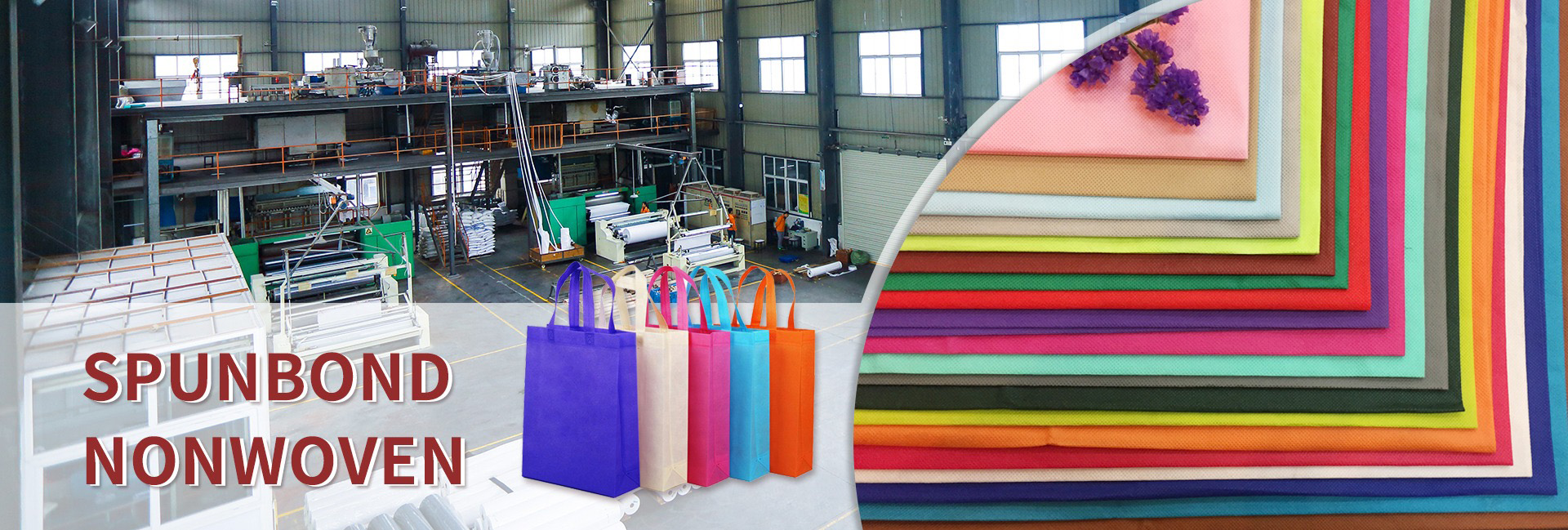
In traditional understanding, the birth of fabric always relies on the two core processes of spinning and weaving, where warp and weft interweave to form the fabric. But there is a special type of “fabric” that does not require spinning or weaving. It only takes more than ten minutes from particle raw materials to become fabric. With efficient technology and excellent performance, it is widely used in medical masks, agricultural coverings, home textiles and other fields. It is PP (polypropylene) nonwoven fabric. Recently, the reporter walked into a PP non-woven fabric production factory and witnessed the entire process of “melting drawing forming net solidification” up close, unlocking the production password for this “non-woven fabric”.
The magical properties of PP non woven fabrics
Entering the factory exhibition hall, various PP non-woven fabric samples are neatly displayed. White medical non-woven fabric is flexible and breathable, colored packaging non-woven fabric is thick and durable, and lightweight agricultural non-woven fabric is transparent and moisture-proof. The staff introduced that PP non-woven fabric, scientific name “polypropylene spunbond non-woven fabric”, is a type of fabric that can be formed without spinning or weaving. It does not have the warp and weft lines of traditional fabrics, but has multiple advantages such as water repellency, breathability, flexibility, and non toxicity and non irritation.
Compared with traditional cotton and synthetic fabrics, the advantages of PP non-woven fabric are very prominent. In terms of production, it abandons complex processes such as spinning and weaving, and adopts a one-step continuous production method, which is several times more efficient than traditional textiles; In terms of performance, it is resistant to aging, UV rays, and corrosion. It can be used indoors for 8 years and naturally decomposes outdoors in just 90 days. There are no toxic residues during combustion, making it a typical environmentally friendly material; In terms of applications, from the inner layer of masks and surgical gowns, to crop cold proof fabrics, furniture dust covers, to shopping bags and car interiors, its presence is everywhere and has already penetrated into every aspect of life.
Many people mistakenly believe that non-woven fabric is’ rough fabric ‘, but in fact it is not. “The technical director of the factory said that by adjusting the raw material formula and production parameters, PP non-woven fabric can be customized with different weights (9-300 grams), widths (up to 3.2 meters), and properties. It can be made into ultra-thin medical protective materials and high-strength industrial filter materials, with flexibility far exceeding traditional fabrics.
Full exploration: from particles to fabric in one go
Passing through the exhibition hall, the reporter entered the fully enclosed production workshop, where the huge production line operated in an orderly manner. Amidst the roar of the machines, white fabric was slowly output from the end of the equipment without human intervention, truly achieving automated production. The entire production line is over 50 meters long, covering eight major processes including feeding, melting, spinning, cooling, stretching, web forming, hot rolling, and winding, all interconnected and seamlessly integrated.
Raw material feeding: Small particle storage machine
At the starting point of the production line, the automatic suction device sucks milky white PP slices (polypropylene particles) from the lower bin into the higher bin, with uniform particle size and rounded shape like rice grains. The raw material is the core of the quality of PP non-woven fabric. We use high-purity polypropylene slices with a melt index controlled between 28-45 to ensure stable spinning in the future. ”According to the staff, color masterbatch (≤ 10%) can be added in production to customize the color, or functional additives can be added to improve the flame retardant and anti-aging properties.
The raw materials enter the main screw extruder through the pipeline, which is the core equipment of the melting process. The extruder is equipped with five independent electric heating zones on the outside, with precise temperature control between 180-220 ℃. The zone heating gradually softens and melts the PP particles, ultimately turning them into a viscous semi flowing melt, like “plastic syrup”.
High temperature spinning to form fine filaments
The melted PP melt is filtered to remove impurities and accurately measured by a metering pump to ensure stable melt flow. Subsequently, the melt is fed into the spinning box and sprayed out through a spinneret filled with micropores – thousands of micrometer sized small holes with a diameter of only 0.2-0.3 millimeters are distributed on the spinneret. The high-temperature melt is extruded from the holes, instantly forming a continuous filamentous melt flow.
This step is the key to the entire production process and also the core of ‘melt drawing’. Before the filamentous melt cools down, the circulating cooling air boxes on both sides immediately blow out cold air at 20-30 ℃. The high-speed airflow rapidly stretches and elongates the fine flow of the melt, cooling and solidifying it into continuous filaments with a diameter of only 1.8-2.5 deniers, finer than human hair. The stretching speed can reach several kilometers per minute, instantly drawing and forming, and the fiber strength and toughness are determined in this step, “the technician added.
Disorderly laying and weaving of a “fiber net”
The PP filament stretched by cold air is in a disordered state under the action of high-speed airflow, evenly dispersed and falling onto the mesh curtain below. The mesh curtain is a breathable mesh belt that runs at a constant speed to transport the scattered filaments to the next stage. At this time, the filament layers are stacked and crisscrossed, forming a fluffy fiber web, similar to “cotton fluff” but more uniform and dense.
The uniformity of the mesh directly determines the thickness and strength consistency of the non-woven fabric, “the staff pointed to the fiber mesh on the mesh curtain and said. By adjusting the airflow speed and the speed of the mesh curtain, the weight and density of the fiber mesh can be controlled. The lightweight version weighs only 9 grams per square meter, while the heavy version can reach 300 grams, meeting the needs of different scenarios.
High-temperature compression synthesis of “real cloth”
The fluffy fiber web itself has extremely low strength and can be easily pulled apart, and the hot rolling mill is the key equipment that turns it into a “sturdy fabric”. After entering the hot rolling mill, the fiber web undergoes slight melting on the surface of the fibers under high temperature and pressure of 150-160 ℃, and adjacent fibers bond to each other, forming a stable fabric structure.
After hot rolling consolidation, the originally fluffy fiber mesh becomes flat and compact, with significantly increased strength, possessing the basic characteristics of fabric. Subsequently, the formed non-woven fabric is cooled and shaped, rolled into large rolls by a winding machine, and then cut into different widths according to requirements by a slitting machine. After packaging, it can be shipped from the factory.
The entire process from feeding PP particles into the equipment to completing the fabric winding only takes about 15 minutes. It is fully automated and continuous, with no wastewater or exhaust emissions. The scraps can also be recycled and reused, making it green and efficient.
Wide application
Don’t be fooled by the simplicity of PP non-woven fabric production, its application scenarios are more extensive than many traditional fabrics. ”The factory manager told reporters that with excellent performance and cost-effectiveness, PP non-woven fabric has become an indispensable material in the national economy, and market demand continues to grow.
The medical and health field is the core application scenario of PP non-woven fabric. The middle filter layer, surgical gown, protective clothing, medical bed sheets, mask ear straps, etc. of medical masks are all made of PP non-woven fabric as raw material. Its breathable, antibacterial, and non-toxic characteristics can effectively ensure the safety of medical staff and patients. In the agricultural field, PP non-woven fabric is used as crop cold insulation cloth, seedling substrate, and grass proof cloth, which can be transparent, moisturizing, inhibit weed growth, and help increase agricultural production and income; In the home furnishing field, PP non-woven fabric is indispensable for the lining of sofas and mattresses, furniture dust covers, disposable bed covers, pillowcases, etc.
In addition, in the industrial field, PP non woven fabric can be used for filtering materials, sound insulation materials, and automotive interiors; In the field of packaging, environmentally friendly shopping bags, gift packaging, express cushioning materials, etc., PP non-woven fabric is also widely used. With the tightening of environmental policies and technological progress, the application scenarios of PP non-woven fabrics are constantly expanding, and the market prospects are broad.
Green Future
At the end of the visit, the reporter saw that the factory’s scrap material recycling device was crushing the waste cloth and scrap materials generated during production and putting them back into the production line, achieving 100% recycling. Our production process is green and environmentally friendly throughout, with no pollutant emissions. The raw materials are biodegradable and recyclable, meeting the requirements of the dual carbon target. “The factory manager stated that in recent years, the company has continuously increased research and development investment, optimized production processes, improved product performance, and developed functional PP non-woven fabrics such as antibacterial, flame-retardant, and superhydrophobic to meet the diverse needs of the market.
The birth of PP non-woven fabric is a technological innovation in the textile industry, from traditional spinning and weaving to one-step melting and drawing. It subverts people’s traditional understanding of “cloth” and has become an indispensable material in modern life with its advantages of high efficiency, environmental protection, and multifunctionality. In the future, with the continuous advancement of technology, PP non-woven fabric will emit light and heat in more fields, bringing more convenience to people’s lives and contributing to green and sustainable development.
Dongguan Liansheng Non woven Technology Co., Ltd. was established in May 2020. It is a large-scale non-woven fabric production enterprise integrating research and development, production, and sales. It can produce various colors of PP spunbond non-woven fabrics with a width of less than 3.2 meters from 9 grams to 300 grams.
Post time: May-17-2026