
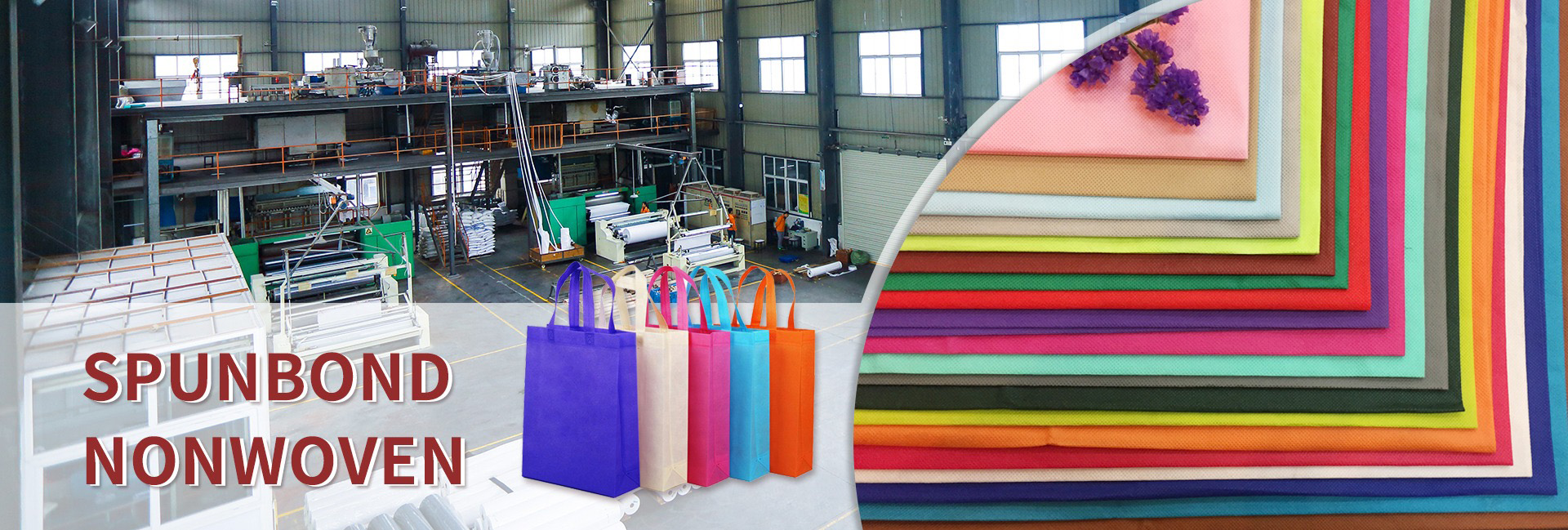
In the polyester non-woven fabric family, spunbond and needle punching processes can be regarded as the “two mainstream technological branches” – the former constructs a dense structure through “continuous filament+thermal bonding”, while the latter creates a fluffy shape through “short fiber+mechanical puncture”. From medical protection to geotechnical engineering, from packaging materials to home textiles, the performance differences between the two directly determine the adaptability of the scene. This “performance showdown” is not simply about “who is better”, but about “how different structures match different needs”. The core differences stem from the essence of the process and are ultimately reflected in the game of key indicators such as mechanics, breathability, and weather resistance.
Process traceability: the essential difference between two “weaving logic”
The root cause of performance differences lies in the fundamental difference between fiber web formation and reinforcement methods – spunbond is “melt direct spinning into a web”, while needle punching is “short fiber combing and piercing”, and the two processes directly shape completely different fiber structure shapes.
(1) Polyester spunbond nonwoven fabric: a “dense network” of continuous filaments
The process flow is “PET slice melting → screw extrusion → spinning hole spraying (1-3dtex continuous filament) → airflow stretching → web formation → thermal bonding reinforcement (hot rolling machine 120-160 ℃)”. Its core features are:
Fiber morphology: 100% continuous filament, fixed between fibers through thermal bonding points, forming a “network structure of node connections” without fiber breakage;
Structural density: high uniformity of mesh formation, weight deviation of ≤± 5%, thin thickness (0.1-0.5mm, weight 10-200g/㎡), smooth surface, no obvious holes;
Process core: Relying on “thermal bonding strength”, the proportion of bonding points is 15% -30%, which determines the fracture strength and water resistance of the finished product.
(2) Polyester needle punched non-woven fabric: the “fluffy interweaving” of short fibers
The process flow is “PET short fibers (length 38-51mm, fineness 2-5dtex) → opening and combing → cross laying mesh → needle punching machine puncture (needle density 100-300 needles/cm ²) → shaping”. Its core features are:
Fiber morphology: Short fibers are randomly interwoven and connected to each other through the crochet hook of a needle punching machine, forming a “three-dimensional winding structure” with fiber ends and pores;
Structural density: The net has high fluffiness, with a weight deviation of ≤± 8%, a thick thickness (0.3-2mm, weight 20-500g/㎡), obvious needle punched holes on the surface, and a rough texture;
Process core: Relying on the “fiber winding tightness”, the needle depth (2-5mm) and needle density determine the fluffiness and tear strength of the finished product.
Core Performance Showdown: Direct Competition of Six Key Indicators
Starting from practical application requirements, we have selected six core indicators, namely “mechanical performance, breathability, weather resistance, washability, filtration, and processing adaptability”, and quantitatively compared them with mainstream products in the industry in 2024 (with a weight of 50g/㎡).
(1) Mechanical properties: Strength game between “continuous filament” and “short fiber winding”
Mechanical properties are the core of material load-bearing and tensile resistance, and the differences between the two are reflected in three dimensions: “fracture strength”, “tear strength”, and “longitudinal and transverse differences”:
Polyester spunbond non-woven fabric fracture strength (N/5cm), longitudinal 28-35, transverse 25-32; The fracture strength of polyester needle punched non-woven fabric (N/5cm) is 20-28 in the longitudinal direction and 15-22 in the transverse direction. The reason is that spunbond continuous filaments have no breakpoints, while needle punched short fibers rely on hooking, resulting in weaker transverse strength.
The tear strength (N) of polyester spunbond non-woven fabric is 8-12, while that of polyester needle punched non-woven fabric is 10-15. The reason is that the needle punched fibers are entangled to form a three-dimensional structure, and more fiber hook points need to be destroyed during tearing.
The longitudinal and transverse strength ratio of polyester spunbond non-woven fabric is 1.1-1.3:1, while that of polyester needle punched non-woven fabric is 1.5-1.8:1. The reason is that the fibers tend to align longitudinally when needle punched and laid, resulting in lower transverse strength.
The wear resistance (wear coefficient) of polyester spunbond non-woven fabric is 0.35-0.4, while that of polyester needle punched non-woven fabric is 0.28-0.32. The reason is that the spunbond surface is dense and the fibers are not easily detached, while the needle punched surface fibers are easily worn.
Polyester spunbond non-woven fabric scene adaptation: For scenarios that require load-bearing and stretch resistance (such as express packaging bags, load-bearing layers of geotextiles), choose spunbond, whose continuous filament structure can stably withstand 5-15kg tensile force; Polyester needle punched non-woven fabric is suitable for scenarios that require tear resistance, such as tent fabrics and outer layers of flood control sandbags. The needle punched structure has a three-dimensional winding structure that is not easily cracked quickly when torn.
(2) Breathability: The debate over breathability between “dense barrier” and “fluffy channel”
Breathability is determined by the size of fiber gaps and structural density, which directly affects the applicability of materials in filtration, insulation, moisture resistance, and other scenarios
Polyester spunbond non-woven fabric: with a breathability of 300-800L/m ² · s, it has moderate breathability due to multiple thermal bonding points, small fiber gaps, and more uniform airflow without obvious “air leakage points”;
Polyester needle punched non-woven fabric: with a breathability of 800-1500L/m ² · s, a large number of three-dimensional pores (pore size 5-20 μ m) are formed due to the winding of short fibers. Its breathability is 1.5-2 times that of spunbond, but it is prone to “turbulence” when airflow passes through, resulting in poor uniformity.
Scene adaptation:
For scenes that require “controllable breathability” (such as mask lining and clothing lining), choose spunbond, which can provide breathability while avoiding direct cold air blowing;
For scenes that require “high breathability” (such as air filters and shoe lining), needle punching can quickly guide airflow and reduce stuffiness.
(3) Weather resistance and chemical stability: anti-aging ability determined by “structural compactness”
Both of them use polyester as raw material (acid and alkali resistant, organic solvent resistant), but the structural differences lead to the differentiation of weather resistance (UV resistance, aging resistance):
UV aging resistance (after 5000 hours of exposure to UVB-313 lamps):
The strength retention rate of spunbond non-woven fabric is 85% -90% (dense structure reduces fiber exposure, and the heat bonding point has stable UV resistance);
The strength retention rate of needle punched non-woven fabric is 75% -80% (fibers in the fluffy structure are easily degraded by UV irradiation, and the risk of fiber breakage at needle punched points is high);
Chemical corrosion resistance (soaked in 5% sulfuric acid solution for 72 hours):
Both have a strength retention rate of over 90%, but the needle punched non-woven fabric has many pores and chemical reagents are easily permeable. If used for liquid filtration, additional anti-seepage treatment is required.
Scene adaptation:
For outdoor long-term use scenarios (such as roof waterproof coiled material base, outdoor sunscreen), spunbond is selected, and the anti-aging life is 30% -50% longer than that of acupuncture;
Choosing needles for indoor or short-term chemical filtration scenarios (such as industrial wastewater pretreatment filtration) is cost-effective and easy to replace.
(4) Washing resistance: anti detachment ability of “thermal bonding” vs “mechanical hooking”
The water resistance determines whether the material can be reused, and the core is the stability of the fiber fixation method
Polyester spunbond non-woven fabric: The hot bonding point is not easy to fall off in water temperatures below 100 ℃, and the strength retention rate is greater than 80% after 5 washes, with no obvious fiber shedding;
Polyester needle punched non-woven fabric: The fibers rely on mechanical interlocking, and after washing for 3 times, fiber looseness is prone to occur, resulting in a strength retention rate of 65% -70%. There may be slight shedding on the surface (especially for low weight products).
Scene adaptation:
For scenarios that require repeated washing (such as medical bed sheets and household cleaning cloths), choose spunbond, which can withstand 5-10 washes while maintaining structural integrity;
For one-time or low-frequency use scenarios (such as car interior soundproofing cotton, disposable filter bags), needle punching is preferred without considering water resistance, resulting in better cost.
(5) Filtering performance: interception effect determined by “aperture uniformity”
The filtering performance depends on the “aperture size” and “aperture distribution uniformity”, both of which have their own advantages in different filtering scenarios:
Micro particle filtration (1-10 μ m, such as dust and pollen):
Spunbond non-woven fabric has uniform pore size (2-5 μ m) and a filtration efficiency of 60% -75%, suitable for “coarse filtration+pre filtration” (such as air conditioning primary filter);
Needle punched non-woven fabric has a wide pore size distribution (5-20 μ m), a filtration efficiency of 50% -65%, but a higher dust holding capacity (able to hold 20% -30% of its own weight of dust), suitable for “medium coarse filtration+high dust holding” scenarios (such as industrial dust removal filters);
Liquid filtration (such as wastewater suspended solids filtration):
Due to its dense structure, spunbond can intercept suspended solids above 5 μ m and is not prone to liquid leakage; Acupuncture is only suitable for intercepting particles larger than 20 μ m due to its large pores, and it needs to be used in conjunction with film coating to improve filtration accuracy.
(6) Processing adaptability: post-processing potential determined by “surface morphology”
Processing adaptability refers to the ability of materials to adapt to subsequent processes such as cutting, compounding, and printing, which affects the production efficiency of the final product
Cutting and sewing:
The spunbond surface is smooth, and the cutting edges are not prone to fuzzing. The stitching has a high degree of fit (suitable for making protective clothing and shopping bags);
The needle punched surface is rough, and the cutting edge is prone to fiber scattering, requiring additional edge locking treatment (suitable for making geotextiles and soundproof cotton that do not require fine sewing);
Composite and Printing:
The surface of spunbond is smooth, and its composite fastness with film and fabric (peel strength>3N/2.5cm) is 20% -30% higher than that of needle punching. The printed pattern has high clarity (suitable for high-end packaging);
The needle punched surface has pores, and more adhesive is needed for lamination. Printing is prone to “smudging” and is only suitable for simple patterns (such as industrial logos).
Scenario based ultimate showdown: the “best choice” in the four major fields
Comparing performance without context is meaningless. We will select four core application areas and see how the two materials can “showcase their strengths”.
(1) Medical protection field: spunbond “barrier is king”
Core requirements: droplet barrier, sterile, and resistant to disinfection;
Advantages of spunbond: The dense structure ensures a droplet barrier rate of over 95% (in accordance with GB 19082 standard), is resistant to 75% alcohol disinfection, and maintains sterility even after water washing;
Acupuncture limitations: Large pores are prone to droplet leakage, and fiber shedding may cause medical contamination. It is only used for non-contact medical accessories (such as hospital bed dust covers).
(2) Geotechnical engineering field: Choose according to needs, each with their own division of labor
Load bearing/anti-seepage scenarios (such as roadbed reinforcement and artificial lake anti-seepage): Choose spunbond, which has high fracture strength (30N/5cm or more) and can resist soil settlement tension, and a dense structure reduces water seepage;
Drainage/filtration scenarios (such as blind drainage ditches and soil filtration layers): Choose needle needles, which have high breathability (1200L/m ² · s or more) and can quickly drain soil water. The fluffy structure can intercept sediment.
(3) Packaging field: spunbond with both appearance and strength
High end packaging (such as electronic product packaging, gift bags): choose spunbond, with a flat surface that can print fine patterns, high breaking strength, and a load-bearing capacity of 8-10kg
Ordinary transportation packaging (such as cardboard box lining, part cushioning): needle punched, with a cost 15% -20% lower than spunbond, and a fluffy structure that provides cushioning protection without the need for fine appearance.
(4) In the field of home textiles, needle punching “wins with fluffiness”
Warmth/Soundproofing Scenarios (such as mattress interlayers and curtain linings): Choose needle punched, fluffy structure with high air content (air content>70%), warmth retention 30% higher than spunbond, and sound insulation volume (20-25dB) better than spunbond (15-20dB);
Lightweight/close fitting scenes (such as underwear lining, towel cloth): Choose spunbond, with a smooth surface without itching, water-resistant and not easily deformed, and a more comfortable fit to the skin.
4、 Showdown Summary: There is no “absolute winner”, only “precise adaptation”
Dimension
Polyester spunbond non-woven fabric is high-strength, dense, weather resistant, washable, with low breathability and high cost. It is suitable for medical protection, high-end packaging, and outdoor building materials, with a cost of 11-13 yuan/square meter
Polyester needle punched non-woven fabric with high breathability, fluffiness, high dust holding capacity, low cost, low strength, poor weather resistance, easy shedding of hair, industrial filtration, home insulation, ordinary cushioning packaging, cost 8-10 yuan/㎡.
The final conclusion of this “performance showdown” is that spunbond is an “all-around player with balanced performance”, suitable for scenarios with high requirements for strength and stability; Acupuncture is a “distinctive cost-effective player” that is suitable for scenarios that require breathability, fluffiness, and are cost sensitive. In practical applications, the two can even work together – such as “spunbond+needle punched composite geotextile“, which uses a spunbond layer to support and prevent seepage, and a needle punched layer to drain and filter, achieving the effect of “1+1>2″.
The key to selection is always “demand first”: when “reliability and stability” are needed, spunbond is the first choice; When high cost-effectiveness and unique features are needed, acupuncture is more suitable. There is no best material, only the one that understands the needs the most.
Dongguan Liansheng Non woven Technology Co., Ltd. was established in May 2020. It is a large-scale non-woven fabric production enterprise integrating research and development, production, and sales. It can produce various colors of PP spunbond non-woven fabrics with a width of less than 3.2 meters from 9 grams to 300 grams.
Post time: Sep-21-2025