
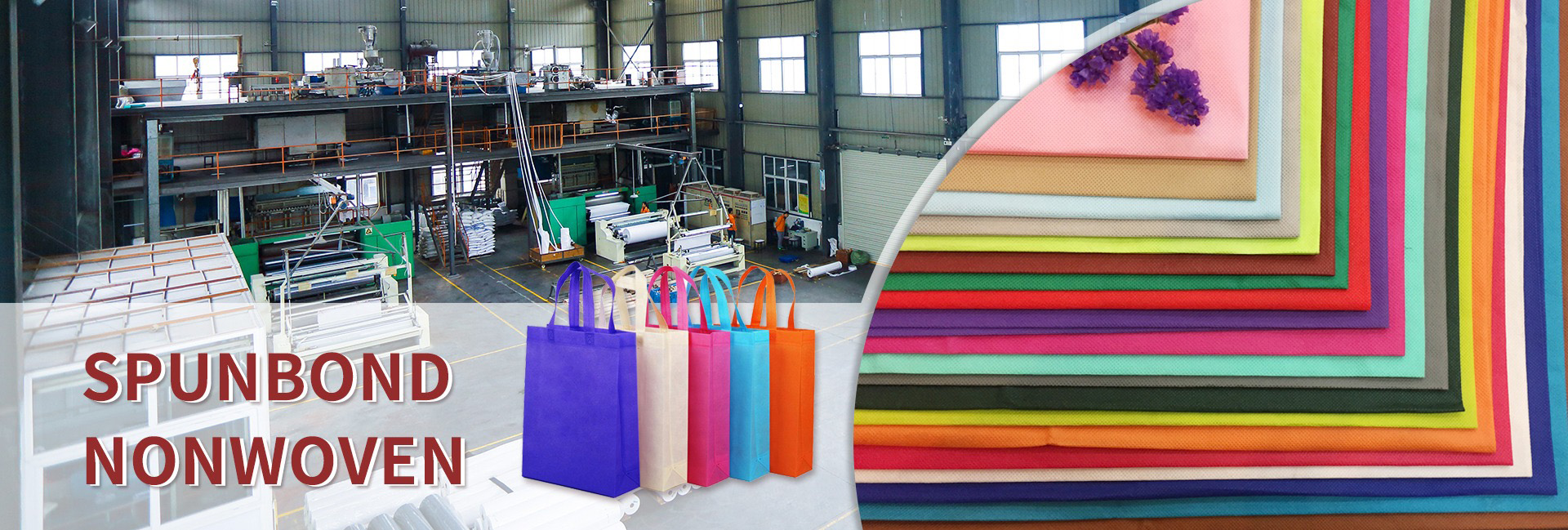
In the non-woven fabric industry, “high strength” and “lightweight” have always been technical pain points that are difficult to balance – conventional polyester spunbond hot-rolled non woven fabrics must increase weight and thicken the fabric surface to ensure high tensile and tear resistance, resulting in bulky products and increased consumables; If pursuing lightweight and portability, there will be problems such as insufficient strength, easy deformation, and poor stability, making it difficult to meet the usage needs of high-end fields.
Now, the bottleneck of this industry has been completely broken! The new generation of polyester spunbond hot-rolled nonwoven fabric has achieved a perfect integration of “high strength, high stability, and lightweight” through full process innovation. It not only overcomes the industry’s recognized technical difficulties, but also promotes the transition of polyester nonwoven fabric from “basic applications” to “high-end upgrades”, injecting new impetus into product innovation in multiple fields.
The dilemma between high strength and lightweight
Polyester spunbond hot-rolled non-woven fabric is made from polyester chips (PET) as raw material, which are melt spun, air drawn, laid, and bonded by high-temperature hot rolling. With the advantages of high temperature resistance, acid and alkali resistance, environmental protection and non toxicity, it is widely used in many fields such as geotechnical engineering, automobile manufacturing, filter materials, medical protection, high-end packaging, etc. But for a long time, the industry has always faced a core dilemma: the inability to balance strength and thinness.
The limitations of traditional products are very obvious: when used in scenarios with high strength requirements such as geotechnical reinforcement and automotive substrates, high weight and thick fabric design are required, which not only increases raw material consumption and transportation costs, but also limits the flexibility of product application; When used in high-end hygiene products, precision filtration, lightweight packaging and other scenarios, lightweight design can lead to insufficient tensile strength and high elongation of the product, which can easily deform and tear under long-term use or stress, greatly reducing stability.
More importantly, as downstream industries transition towards “lightweight, high-performance, energy-saving and environmentally friendly”, the market’s requirements for polyester spunbond hot-rolled nonwoven fabrics are becoming increasingly stringent – they need to meet the high-strength standards of longitudinal tensile strength ≥ 35N/5cm and elongation at break ≤ 25%, while also achieving weight reduction and lightweight fabric surface, while ensuring dimensional stability and durability, which poses a high challenge to production technology.
Three core upgrades to solve industry problems
The core breakthrough of the new generation of polyester spunbond hot-rolled nonwoven fabric is not the improvement of a single link, but the innovation of the entire process from raw materials, spinning to hot rolling. Through the upgrading of three core technologies, it has achieved the dual empowerment of high strength and lightness, completely breaking the bottleneck of the industry.
Firstly, upgrading the modification of raw materials to build a strong foundation. Unlike traditional products that use conventional polyester chips, the new generation of products uses high viscosity homopolymer polyester chips and optimizes the molecular chain structure through solid-phase thickening technology to create a “long chain+high crystallinity” raw material system – its intrinsic viscosity is ≥ 0.72dl/g, much higher than the 0.64dl/g of conventional chips. Longer molecular chains can form a tighter winding network, which is not easy to break when stretched, and improves the mechanical properties of fibers from the source. At the same time, adding specialized modified masterbatch can increase the tensile strength of the fiber itself by more than 30% without the need for additional weight, balancing the dual requirements of lightness and strength .
Secondly, the innovation of spinning technology aims to achieve fiber refinement. By adopting twin-screw extrusion technology and dual row intelligent spinning system, the temperature and pressure parameters of the melt spinning process are optimized, and the screw melting temperature is precisely controlled at around 295 ℃, ensuring that the polyester chips are fully melted and not carbonized . By precisely controlling the aperture (0.2-0.8mm) and hole shape (circular, trilobite, etc.) of the spinneret, the spun fibers have a more uniform diameter and finer fineness. At the same time, high-pressure airflow stretching technology is used to make the fiber arrangement more regular, effectively improving the bonding force between fibers and enabling the lightweight fabric surface to have excellent overall strength. In addition, the dual row intelligent wire swinging system makes the fiber mesh laid more evenly, greatly improving the weight uniformity and ensuring consistent longitudinal and transverse strength, further enhancing product stability .
Thirdly, optimize the hot rolling process to balance adhesion and flexibility. Breaking through the limitations of traditional hot rolling with “high temperature and high pressure”, precise temperature control hot rolling technology is adopted to control the hot rolling temperature at 200-300 ℃, adjust the line pressure to 100-150N, and match it with customized engraved rollers (engraved density of 60-80%, engraved depth of 0.01-0.1mm). This process not only enables local melting of fibers to achieve strong bonding, forming uniform and dense rolling points, avoiding problems such as weak bonding and delamination, but also prevents excessive melting and brittleness of fibers, preserving their flexibility and achieving the effect of “high strength without stiffness, lightweight without fragility”. At the same time, it greatly improves the dimensional stability of the product, making it less likely to deform or shrink after long-term use.
High strength and stability, lightweight and practical dual online
After the full process technological innovation, the performance of the new generation of polyester spunbond hot-rolled non-woven fabric has achieved a comprehensive leap, perfectly balancing high strength, high stability, and lightweight. Multiple core indicators far exceed industry standards, demonstrating unique product competitiveness.
In terms of high strength, the longitudinal tensile strength of the product can reach 35-50N/5cm, the transverse tensile strength can reach 25-40N/5cm, and the elongation at break is controlled at 20%~25%, which is much better than conventional products (the elongation of conventional products is mostly 30%~40%); The tear resistance and top burst resistance of traditional products have been improved by more than 40%. Even under long-term stress and complex environments, the structure can remain intact and is not easily torn or damaged. At the same time, the creep rate of the product is controlled within 5%, much lower than the 12% of conventional products. In geotechnical reinforcement and other scenarios, it can effectively resist soil pressure, avoid roadbed settlement, and extend its service life to more than 5 years.
In terms of stability, relying on raw material modification and process optimization, the product has excellent dimensional stability. In extreme temperature environments of -50 ℃~150 ℃, the shrinkage rate is ≤ 1%, and there will be no problems such as deformation, brittleness, cracking, etc. At the same time, it has good acid and alkali resistance, anti-aging performance, and anti gamma ray characteristics, so that it can be sterilized by gamma ray without destroying physical properties. This advantage is not available for polypropylene non-woven fabrics, and it is suitable for medical, chemical and other special scenes . In addition, the product has a uniform and defect free surface, clear and regular rolling points, and no appearance problems such as flying or clumping, further enhancing the practicality of the product.
In terms of lightweight, the weight of the product can be controlled between 15~50g/㎡, which is 30%~50% lower than traditional high-strength products. The fabric thickness is only 0.2~0.7mm, and the texture is light, thin, and soft. It not only significantly reduces raw material consumption and production costs, but also improves the application flexibility of the product, which can adapt to more high-end scenarios that require lightweight . At the same time, the product’s air permeability increases by 80% compared to traditional products, and the filtration resistance decreases by 50%, achieving efficient and low resistance use in filtration scenarios .
Unlocking new scenarios for high-end applications
The technological breakthrough of the new generation of polyester spunbond hot-rolled non-woven fabric not only solves the pain points in the industry, but also broadens the application boundaries of polyester non woven fabric. With its core advantages of high strength, stability, and lightness, it has been widely used in multiple high-end fields, replacing traditional products and promoting industry upgrading.
In the field of geotechnical engineering, it can be used for roadbed reinforcement, slope protection, waterproofing membrane base cloth and other scenarios. With high strength and low creep rate, it can effectively resist soil pressure and water flow impact, prevent pavement cracking and roadbed settlement, greatly improve engineering durability, and has become the first choice for high-end geotechnical materials ; In the field of automobile manufacturing, it can be used as a base material for seat belts, car roofs, filters, etc. Lightweight design can reduce the weight of cars and save energy consumption. High strength characteristics can meet the needs of car safety protection. At the same time, its advantages of high temperature resistance and strong stability are suitable for the complex use environment of cars.
In the field of filtration, it can be used in high-end air filtration, transmission oil filtration and other scenarios. Its high efficiency, low resistance and high strength characteristics can ensure filtration efficiency (0.3-0.5 μ m particle capture efficiency ≥ 57%) while extending the service life of filter materials, replacing traditional fiberglass filter paper, and solving its problems of high resistance and easy damage ; In the medical field, it can be used for surgical gowns, medical masks, disinfection packaging, etc. It has the advantages of being environmentally friendly, non-toxic, and capable of gamma ray disinfection. Combined with its lightweight, breathable, and high-strength characteristics, it enhances the comfort and safety of medical protection.
In addition, in the fields of high-end packaging, hygiene products, agricultural protection, etc., the new generation of products can also play a unique advantage – in high-end packaging, lightweight design can reduce packaging consumables, and high-strength characteristics can protect internal products; In hygiene products, the lightweight and soft texture enhances comfort while ensuring stable product structure; In the field of agriculture, it can be used as crop protective cloth, fruit bags, etc., with strong aging resistance and stability, suitable for complex outdoor environments .
Promoting the high-end upgrading of the nonwoven fabric industry
The breakthrough of high-strength and lightweight technology in the new generation of polyester spunbond hot-rolled non-woven fabric not only breaks the technological monopoly of foreign high-end products, but also promotes the transformation of China’s non-woven fabric industry from “scale expansion” to “quality improvement”, which has important industry significance .
From the production end, lightweight design significantly reduces raw material consumption and transportation costs, while optimizing the entire process improves production efficiency, reduces the rate of unqualified products, and achieves the production goals of “energy conservation, environmental protection, cost reduction, and efficiency improvement”; From the application side, the high-performance advantage of the product meets the development needs of downstream industries for high-end and lightweight, promoting product upgrades in fields such as healthcare, automotive, and geotechnical engineering; From the perspective of industry development, this technological breakthrough provides new ideas for technological innovation in the non-woven fabric industry, drives the overall technological level of the industry to improve, and helps China become the core battlefield of the global high-end non-woven fabric industry.
With the continuous upgrading of downstream industries, the demand for high-performance polyester spunbond hot-rolled nonwoven fabrics in the market will continue to grow. In the future, relying on technological innovation, the new generation of products will further optimize performance, expand more high-end application scenarios, and continue to lead the non-woven fabric industry towards the direction of “high strength, stability, lightness, and environmental protection”, injecting new momentum into the high-quality development of multiple industries.
Dongguan Liansheng Non woven Technology Co., Ltd. was established in May 2020. It is a large-scale non-woven fabric production enterprise integrating research and development, production, and sales. It can produce various colors of PP spunbond non-woven fabrics with a width of less than 3.2 meters from 9 grams to 300 grams.
Post time: Apr-07-2026