
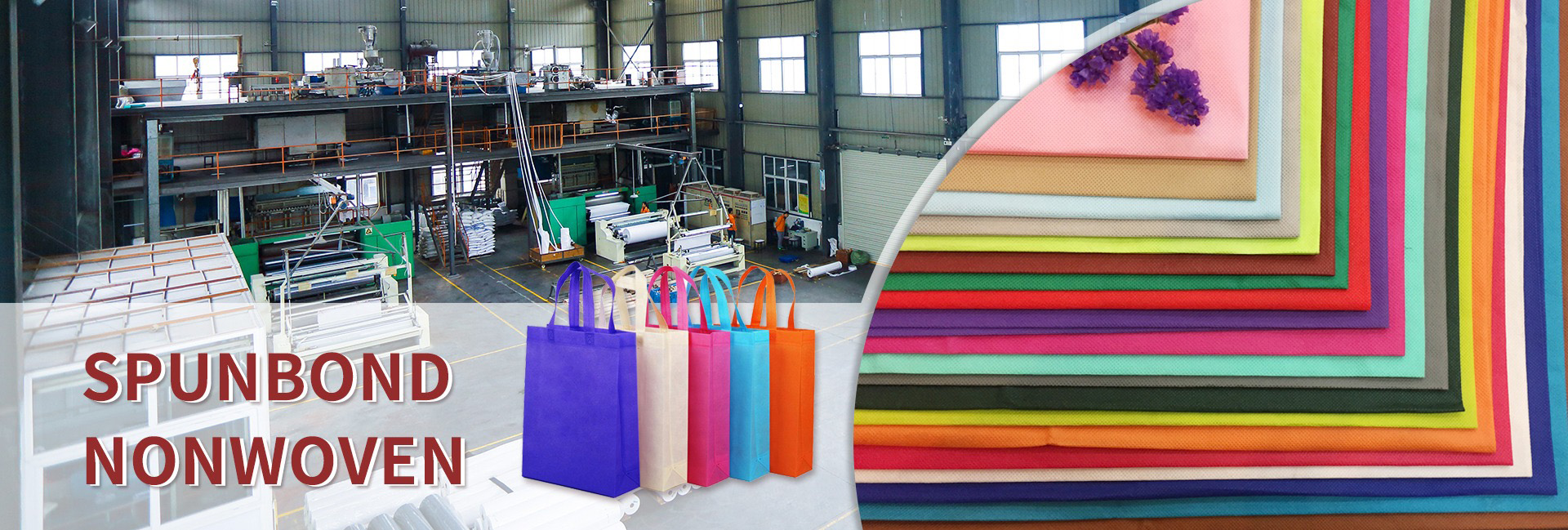
The construction of building foundations can easily cause soil settlement and structural cracks, while greening projects face challenges such as dust from exposed soil layers and soil erosion on slopes, which not only affect construction safety and quality, but also violate ecological and environmental protection construction requirements. Spunbond non-woven fabric, with its controllable three-dimensional fiber structure, excellent tensile strength, and breathable filtration characteristics, combined with diverse modification processes, has become a low-cost and high-performance material that balances “dust control” and “structural/soil stability” in two major projects.
It breaks the limitations of traditional protective materials with “single function” and achieves “two-way stability maintenance” – not only preventing and controlling cracks in foundation structures and reinforcing soil, but also curbing the spread of dust in greening projects and reducing soil erosion, adapting to the dual needs of construction and ecological engineering. The following is a detailed analysis based on industry standards, engineering cases, and measured data.
Material and process advantages of spunbond non-woven fabric adaptation engineering for stability maintenance
Spunbond non-woven fabric can undertake the important task of engineering stability, and its core lies in its material characteristics and process adaptability. It can be flexibly adjusted according to different working conditions of foundation and greening, taking into account strength, breathability, and environmental protection, and meeting the needs of large-scale construction. Its core advantages and adaptation foundation are as follows:
In terms of material selection, polypropylene (PP) and polyester (PET) are the core raw materials, accounting for 68.5% and 22.3% respectively. The proportion of biodegradable fibers gradually increases to 9.2%, which is suitable for different engineering scenarios. PP spunbond focuses on low cost, acid and alkali resistance, and lightweight, and is suitable for ordinary foundations and green coverage; PET spunbond focuses on high temperature resistance, high tensile strength, and weather resistance. After modification, the tensile strength can reach 6-56kN/m, which is suitable for high-strength foundation reinforcement and outdoor slope protection. It meets the requirements of GB/T 17639-2023 “Geosynthetics: Long filament spunbond needle punched nonwoven geotextiles” standard. After 500 hours of ultraviolet irradiation, the strength retention rate still reaches 70% -80%, and it can withstand long-term outdoor service.
In terms of technology and structure, the spunbond method holds a dominant market position of 75.8% due to its high production efficiency and strong product strength. Through melt spinning, mesh laying, needle punching, or hot rolling consolidation, a three-dimensional network entanglement structure is formed, with a porosity of 70% -90% and an equivalent pore size controlled between 0.05-0.30mm. It can achieve “breathable and leak proof, filter and not block pores” – it can not only allow soil moisture to circulate, but also intercept fine soil particles, block dust diffusion, disperse soil stress, buffer structural deformation, and achieve a dual effect of dust prevention and structural stability. High end scenarios use SMS composite technology or fiber-reinforced modification, such as DuPont Kevlar fiber-reinforced spunbond materials from the United States. The tensile strength is 3-5 times that of traditional PP materials, and the long-term weather resistance life can reach more than 20 years. It is suitable for extreme working conditions such as slope protection and deep foundation reinforcement.
The core performance has outstanding adaptability, meeting the requirements of ASTM D4491 and AASHTO M288 standards: longitudinal and transverse tensile strength of 6-56kN/m, elongation at break of 30% -100%, CBR bursting strength of 0.9-8.7kN, which can effectively disperse stress, resist soil settlement and slope slip; The vertical permeability coefficient reaches 10 ⁻¹ -10 ⁻³ cm/s, balancing drainage and filtration to avoid softening and instability caused by soil water accumulation. At the same time, through physical shielding and particle interception, dust can be reduced by more than 40%, significantly reducing the risk of construction dust pollution.
Focusing on crack prevention and control, building a strong defense line for structural stability maintenance
The core stability maintenance requirements for building foundations (including roadbeds, foundation pits, and soft soil foundations) are “preventing and controlling settlement cracks, reinforcing soil structures, and reducing construction dust”. Spunbond non-woven fabrics use the triple functions of “reinforcement, isolation, and buffering” to solve the two major pain points in foundation construction, and are suitable for various foundation scenarios such as residential, road, and municipal engineering, especially for soft soil foundations and old road renovation projects.
(1) Crack prevention and control: dispersing stress, blocking the generation and extension of cracks
Foundation cracks are often caused by uneven settlement of soil, concentrated loads, or freeze-thaw cycles. Spunbond non-woven fabrics, with their excellent tensile and stress dispersion capabilities, achieve a crack prevention and control effect of “using softness to overcome rigidity”. In soft soil foundation treatment, PET spunbond non-woven fabric is laid between the replacement layer and the original soil layer as a reinforcement layer to disperse the upper load, avoid uneven soil compression caused by excessive local stress, reduce foundation settlement by 20% -30%, and block the occurrence of settlement cracks; At the same time, its elongation at break is ≥ 80%, which can adapt to small deformations of the foundation, buffer the structural stress caused by freeze-thaw cycles, and avoid further extension of cracks. Especially in the construction of foundations in high-altitude areas, the cracking cycle of overlying structures can be extended by more than 30%.
In the foundation reinforcement of old road reconstruction, spunbond non-woven fabric is used as a crack prevention isolation layer laid between the old roadbed and the new base. It can isolate fillers of different particle sizes, avoid structural unevenness caused by mixing, and buffer the impact stress caused by vehicle loads, reducing reflection cracks. It has been measured that the occurrence rate of roadbed cracks can be reduced by more than 65%. In terms of material selection, PET filament spunbond needle punched fabric with a nominal strength of 18-36kN/m is preferred. The dynamic perforation diameter is ≤ 20mm, and the puncture resistance is excellent, avoiding damage during construction and affecting the crack prevention effect. It fully meets the technical requirements of high-end engineering in GB/T 17639-2023 standard.
(2) Dust control: physical obstruction, control of dust throughout the entire construction process
During foundation construction, large amounts of dust are easily generated during earthwork excavation, filling material stacking, transportation, and other processes. Spunbond non-woven fabric achieves full process dust control through physical coverage, replacing traditional dust nets and adapting to long-term exposed foundations and temporary soil stacking scenarios. For the exposed foundation after excavation, PP spunbond non-woven fabric is fully covered, and its dense three-dimensional structure is used to block wind erosion and prevent the diffusion of fine soil particles. The dust suppression rate can reach over 90%, which is better than the prevention and control effect of traditional 6-needle dust nets; For temporarily stacked earthworks, sand and gravel materials, waterproof modified spunbond non-woven fabric is used to cover them, which not only prevents the spread of dust but also avoids material loss caused by rainwater erosion. It balances dust control and material protection, and meets the requirements of environmental protection control in construction (watering every 2 hours+full coverage protection).
(3) Engineering case and actual test results
A municipal road soft soil foundation project uses PET spunbond non-woven fabric with a nominal strength of 24kN/m as the reinforcement layer, laid under a 30cm thick graded sand and gravel replacement layer. After 6 months of monitoring, the maximum settlement of the foundation is controlled within 5mm, and there are no obvious cracks. Compared with the section without spunbond material, the crack occurrence rate is reduced by 72%; During the construction period, the exposed foundation and soil pile are fully covered with spunbond non-woven fabric, and the surrounding dust concentration is reduced to below 0.15mg/m ³, which meets the “Construction Site Dust Emission Standards”. Another old road renovation project used SMS composite spunbond fabric as the crack prevention layer. After completion, the incidence of reflective cracks in the roadbed was reduced by 68% compared to traditional processes, and the overall stability of the roadbed was improved by 40%, greatly extending the service life of the road.
Focus on dust control and soil stability, while also considering ecology and protection
The core stability requirement of greening projects (including slope greening, bare land greening, and seedling greening) is to “curb dust in exposed soil layers, prevent soil erosion on slopes, and stabilize soil structure”. Spunbond non-woven fabrics, with their characteristics of breathability, moisture retention, soil stabilization, dust suppression, and noise reduction, are suitable for different greening scenarios, solving ecological and environmental pain points while helping vegetation survive, achieving the dual value of “protection+ecology”. Currently, the demand in the field of ecological restoration accounts for 45.2%, and slope protection accounts for 32.8%, becoming one of the core protective materials for greening projects.
(1) Dust control: full coverage protection, solving the problem of dust on exposed land
In greening projects, the exposed land before seedling planting and the temporary slope after slope excavation are the main sources of dust generation. The spunbond non-woven fabric achieves precise dust control through layered coverage. For large areas of exposed green land, lay lightweight PP spunbond non-woven fabric (weight 30-60g/m ²), balancing breathability and dust suppression, which not only blocks wind erosion and dust, but also does not affect soil breathability and rainwater infiltration, avoiding soil compaction; For the slope surface, high-strength PET spunbond non-woven fabric is used, combined with anchor rods for fixation, to prevent the soil layer on the slope from being eroded by wind, while buffering rainwater erosion, reducing dust and soil erosion. The dust suppression rate can reach over 85%, suitable for large-scale exposed green scenes such as mine restoration and road slopes.
In seedling greening scenes, spunbond non-woven fabric can be directly covered on the surface of the seedling bed. For example, in the Linjiang Forestry Red Pine Seedling Base, the use of non-woven fabric covering technology on the seedling bed not only effectively reduces soil moisture evaporation and suppresses dust, but also buffers the damage of wind, rain, and hail to the seedlings, resists bird and pest infestations, and suppresses weed growth. This increases the germination rate of red pine seeds from 60% to over 80%, greatly improving seedling efficiency, reducing seedling costs, and balancing dust control and ecological seedling needs.
(2) Soil stability maintenance: soil stabilization and erosion prevention, assisting vegetation survival and slope stability
In slope greening and large-scale greening, soil erosion and loose structure are the core challenges. Spunbond non-woven fabric stabilizes soil structure through the dual function of “soil stabilization+filtration”, laying a solid foundation for vegetation growth. In slope greening, spunbond non-woven fabric is laid on the slope surface, and then covered with planting soil and vegetation. Its three-dimensional structure can intercept fine soil particles, avoid soil erosion caused by rainwater erosion, and disperse the impact force of rainwater to reduce the generation of slope erosion ditches, which can reduce soil erosion by more than 40%; For greening desertified soil, spunbond non-woven fabric can fix sand particles, prevent desertification from spreading, intercept water and nutrients, improve soil permeability, help vegetation root and survive, and adapt to desertification land restoration and mining ecological management projects.
In terms of material selection, weather resistant PET spunbond non-woven fabric is preferred for slope greening, with a nominal strength of ≥ 12kN/m, UV resistance, and a long-term exposed strength retention rate of not less than 70% to avoid aging and damage; The greening of desertified soil uses PP spunbond non-woven fabric with higher porosity, which balances sand fixation and breathability, and is suitable for the growth needs of sandy vegetation; High end slope protection uses Kevlar fiber reinforced spunbond material, with a weather resistance life of up to 25 years, suitable for long-term soil stability requirements in extreme environments.
(3) Engineering case and actual test results
A certain mine ecological restoration slope greening project uses PET spunbond non-woven fabric with a nominal strength of 18kN/m to lay the slope surface, covering the planting soil and planting local vegetation such as purple locust and dog tooth root. After one year of monitoring, there was no significant soil erosion on the slope surface, and the dust suppression rate reached 92%. The vegetation survival rate increased to 88%. Compared with the slope without spunbond materials, the amount of soil erosion was reduced by 75%, successfully achieving the triple goal of “dust control+slope stability+ecological restoration”. The practice of Linjiang Forestry Red Pine Seedling Base has shown that spunbond non-woven fabric covering not only solves the problem of seedling dust, but also optimizes the seedling environment, greatly improves the survival rate of seedlings, and has become a standardized process for large-scale seedling cultivation; A municipal green bare land project adopts PP spunbond non-woven fabric full coverage, reducing dust concentration by 85% compared to uncovered areas and increasing soil moisture content by 20%, laying a good foundation for subsequent seedling planting and reducing the cost of dust environmental protection rectification.
Technical adaptation and construction key points
(1) Material and specification adaptation
Strictly following the relevant standards of GB/T 17639-2023 and ASTM, precise selection is made according to the engineering scenario: PET filament spunbond fabric is used for reinforcing and crack prevention of building foundations, with a nominal strength of 18-56kN/m and a weight of 150-300g/m ²; PP spunbond fabric with a weight of 60-100g/m ² is used for dust cover on the foundation; PP spunbond fabric with a weight of 30-60g/m ² is used for covering the exposed green land; Slope greening and ecological restoration use PET spunbond fabric or Kevlar reinforced composite fabric, with a nominal strength of 12-36kN/m and a weight of 100-200g/m ², to ensure that the performance is suitable for the working conditions.
(2) Construction specifications
1. Laying requirements: In foundation engineering, spunbond non-woven fabric should be laid flat, without wrinkles or damage, with a lap width of ≥ 30cm, and fixed by lap stitching or hot welding to avoid displacement during construction; The green slope should be laid in accordance with the slope surface and fixed with anchor rods or soil compaction to prevent detachment caused by wind and rain erosion. 2. Construction sequence: In foundation engineering, first level the soil layer, then lay the spunbond material, and finally lay the filling material and compact it; In greening projects, the slope is first trimmed and formed, and then covered with planting soil after laying spunbond materials. Vegetation planting is then carried out, and the seedling scene can be directly covered on the surface of the seedbed after sowing. 3. Post maintenance: Regularly inspect the damage and aging of spunbond non-woven fabrics, repair or replace damaged parts in a timely manner, and prioritize the use of UV resistant modified products in outdoor scenes to extend their service life and ensure long-term stability.
(3) Quality control
The incoming materials need to be tested for tensile strength, elongation at break, equivalent pore size, UV resistance, and other indicators to ensure compliance with engineering standards and design requirements, and to eliminate appearance defects such as needle breakage residue; During the construction process, strict control should be exercised over the smoothness of the laying and the quality of the overlap to avoid any impact on the stability maintenance effect due to improper laying; After completion, monitor indicators such as dust concentration, foundation settlement, and soil erosion to ensure compliance with environmental and engineering quality standards. Material testing reports and construction records must be provided during project acceptance.
Summary: Bi directional stability maintenance empowers green and efficient construction of engineering projects
Spunbond non-woven fabric, with its comprehensive advantages of controllable material, excellent performance, low cost, and wide adaptability, achieves a two-way stability maintenance of “dust control+structure/soil stability” in building foundations and greening projects, breaking the limitations of traditional protective materials with single functions – not only building a solid crack prevention line for building foundations, reducing structural hazards, controlling construction dust, and ensuring project quality and construction safety; It also helps to curb the spread of dust and stabilize soil structure for greening projects, and supports ecological restoration and vegetation survival, in line with the trend of green construction and “dual carbon” development.
At present, spunbond non-woven fabric has become the core protective material for two major projects, with a domestic market concentration of about 35.6%. Enterprises such as Shandong Junfu and Jiangsu Yongding have achieved large-scale production. At the same time, with the iteration of bio based materials and fiber-reinforced modification technology, its weather resistance, tensile strength, and environmental performance continue to improve, gradually adapting to more stringent engineering conditions, especially in the application of high-end slope protection, deep foundation reinforcement and other scenarios.
In the future, as the requirements for stability and environmental standards in construction and ecological greening projects continue to increase, spunbond non-woven fabrics will further replace traditional protective materials, optimize construction processes, reduce operation and maintenance costs, and promote the development of the industry towards high-performance, green, and customized directions, providing more reliable material support for engineering construction and ecological protection, truly achieving the construction goal of “bidding farewell to dust and cracks”, and empowering green and efficient upgrading of engineering.
Dongguan Liansheng Non woven Technology Co., Ltd. was established in May 2020. It is a large-scale non-woven fabric production enterprise integrating research and development, production, and sales. It can produce various colors of PP spunbond non-woven fabrics with a width of less than 3.2 meters from 9 grams to 300 grams.
Post time: Feb-10-2026