
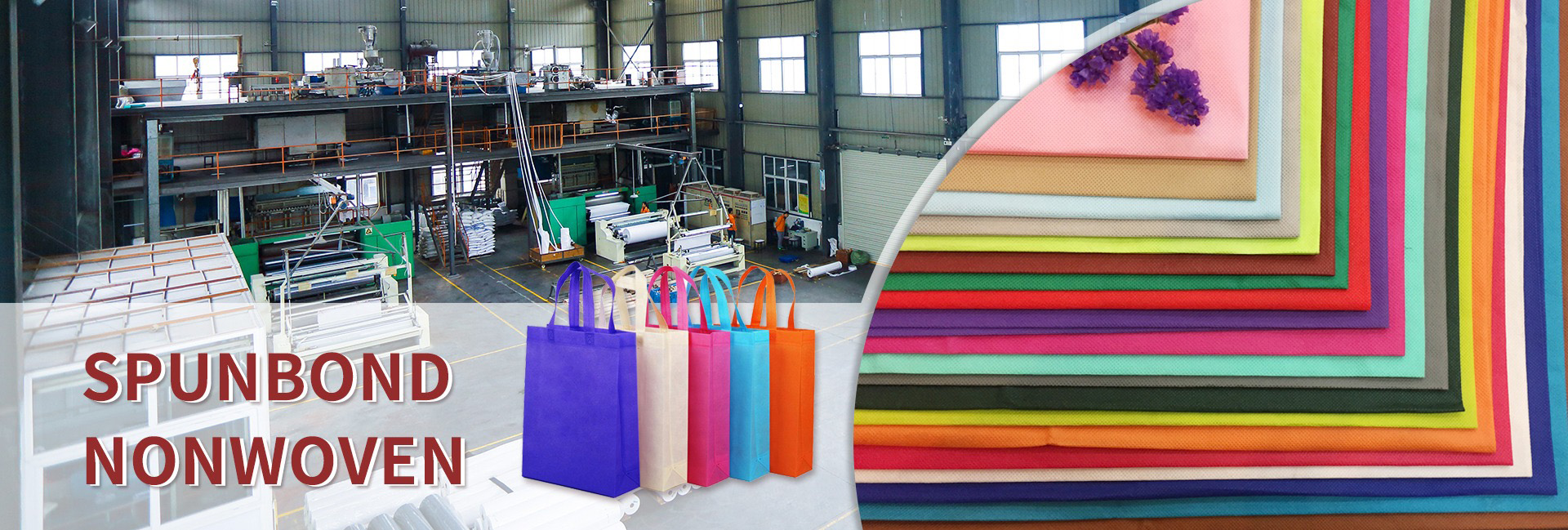
Without spinning or weaving, the inconspicuous polypropylene (PP) particles can be transformed into soft and practical non-woven fabrics in just over ten minutes through a set of automated production lines and “magic processing”. At a large PP non-woven fabric factory, the production line with a daily output of 100 tons runs 24 hours a day, and more than 4 tons of non-woven fabric are produced every hour, widely transported to various fields such as healthcare, agriculture, and home furnishings.
Many people are curious about how this “miracle” of producing 100 tons per day can be achieved? Seemingly simple non-woven fabric hides a rigorous process logic behind it. Today, we will enter the core area of the production line and dismantle the 5 core process steps from polypropylene particles to finished non-woven fabrics, step by step unveiling the mysterious veil of this “efficient production line”.
Unlike the complex processes of traditional textiles, the production of PP non-woven fabric adopts a “one-step continuous production” method. The entire production line is over 50 meters long, fully automated and without manual intervention, ensuring both efficiency and stability of product quality. And the starting point of all of this is small polypropylene particles.
Raw material pretreatment+automatic feeding, laying a solid foundation for quality
The production line with a daily output of 100 tons has a huge demand for raw materials and strict requirements for raw material quality – only high-purity and well uniform polypropylene particles can ensure smooth spinning and produce non-woven fabrics with toughness and strength standards.
The first step in production is raw material pretreatment. The factory selects high-purity polypropylene slices (particles) with a melt index between 28-45, with particle sizes as uniform as rice grains and a pure white color without impurities. According to product requirements, workers will add an appropriate amount of color masterbatch (not exceeding 10%) to the raw materials for customizing non-woven fabrics of different colors; If functional non-woven fabrics (such as antibacterial and flame-retardant) need to be produced, corresponding functional additives will be added, thoroughly stirred and mixed to ensure that the additives are evenly dispersed in the PP particles.
After the preprocessing is completed, the automatic suction device is activated to suck the mixed PP particles from the low-level bin into the high-level bin, and then precisely transport them to the main screw extruder through a closed pipeline without dust leakage throughout the process, which is both environmentally friendly and efficient. It is worth mentioning that the automation level of raw material transportation in the entire production line is extremely high. Only 1-2 workers are needed to monitor the operation of the equipment, which can meet the daily supply demand of 100 tons of raw materials.
Melt plasticization, turning the particles into a “viscous melt”
The PP particles entering the main screw extruder will undergo their first “transformation” – from solid particles to viscous semi flowing melt. This step is the core foundation of the entire production process, and the precision of temperature control directly determines the quality of the melt.
The main screw extruder is equipped with five independent electric heating temperature zones on the outside, and the temperature gradually increases from the feeding end to the discharging end, precisely controlled at 180-220 ℃. After entering the extruder, PP particles are gradually heated in different temperature zones under the rotation and pushing of the screw, softening and melting slowly, and finally forming a uniform and viscous PP melt with a texture like warm “plastic syrup”, without clumping or bubbles, ensuring smooth spinning in the future.
In order to remove impurities and bubbles from the melt, the melted PP melt undergoes a precision filtration process to intercept small impurities and ensure the purity of the melt. The filtered melt is then accurately measured by a metering pump, and the output flow rate of the melt is strictly controlled to ensure that each fiber sprayed out has uniform thickness, laying the foundation for the subsequent quality of the mesh.
Melt spinning, high-temperature spinning and stretching into ultrafine fibers
If melt plasticization is the “preparatory work”, then melt spinning is the “core link” of PP non-woven fabric production – this step, the viscous melt will be converted into fine fibers, which is also the key to “drawing” and directly determines the strength and toughness of the non-woven fabric.
The measured PP melt is transported to the spinning box, which is equipped with spinnerets filled with micropores. Each spinneret is distributed with thousands of micrometer sized small holes, with a diameter of only 0.2-0.3 millimeters. The high-temperature melt is extruded at high speed from these tiny holes, instantly forming a continuous filamentous melt flow, like countless small “melt filaments”.
Before the filamentous melt cools and solidifies, the circulating cooling air boxes on both sides of the spinneret immediately start, blowing cold air at 20-30 ℃. The high-speed airflow rapidly stretches and elongates these fine streams of melt, instantly cooling and solidifying, forming continuous filaments with a diameter of only 1.8-2.5 deniers – finer than human hair filaments. The strength and toughness of each fiber are determined during this stretching process.
For a production line with a daily output of 100 tons, the efficiency of the spinning process is crucial. The stretching speed here is as high as several kilometers per minute, and the spinneret continuously sprays fibers, providing sufficient “raw materials” for the subsequent web forming process.
Form a net and consolidate it, allowing the fibers to “clump” together to form a fabric blank
After stretching and cooling, the PP filament, although fine, is still dispersed as a single fiber and cannot be directly made into non-woven fabric. This requires two steps of forming a net and solidifying to make these fibers “clump” and form a fabric with a certain strength.
Firstly, the networking process. After cooling, the PP filament is uniformly dispersed in a disordered state under the action of high-speed airflow, and slowly falls onto the uniformly running mesh curtain below. The mesh curtain is a breathable mesh belt, and the operating speed can be flexibly adjusted according to the weight of the product. The fibers are stacked and criss crossed on the upper layer of the mesh belt, gradually forming a fluffy fiber network, similar to soft cotton wool, but more evenly and densely distributed.
At this point, the strength of the fiber web is extremely low, and it will spread apart with a gentle pull. The fibers must be bonded to each other through a consolidation process. The current mainstream consolidation method is hot rolling consolidation. The fluffy fiber web is transported to the hot rolling mill, and under high temperature and certain pressure of 150-160 ℃, the fiber surface is slightly melted, and adjacent fibers are bonded to each other, forming a stable fabric structure.
After hot rolling and solidification, the originally fluffy fiber web becomes flat and compact, with significantly increased strength, officially becoming the “fabric blank”. At this point, the fabric blank has the basic characteristics of non-woven fabric, soft and tough.
Post processing+winding and slitting, finished product leaving the factory
After the fabric is formed, it needs to go through a series of post-processing procedures to become a qualified finished non-woven fabric and ultimately enter the market. This step may seem simple, but it directly affects the final quality and user experience of the product.
The first step is cooling and shaping. The fabric billet that has just come out of the hot rolling mill has a high temperature and needs to be cooled by a cooling device to shape the fabric surface and avoid wrinkles and deformation during subsequent winding. After cooling, the fabric blank will undergo surface treatment – depending on the needs, it can be treated with hydrophilic treatment (for medical and sanitary products) or water repellent treatment (for waterproof packaging and agricultural coverage) to improve the product’s performance.
After processing, the fabric blank is transported to the winding machine and rolled into large rolls with a diameter of 1-1.5 meters, each weighing several hundred kilograms. Subsequently, the large roll of non-woven fabric is sent to the slitting workshop, where the slitting machine cuts it into finished products of different widths and lengths according to customer needs. After inspection and packaging, it can be shipped out of the factory.
The entire process from feeding polypropylene particles into the equipment to packaging the finished non-woven fabric before leaving the factory only takes about 15 minutes. However, this production line operates 24 hours a day and can produce 100 tons of non-woven fabric per day, which is equivalent to producing nearly 200000 square meters of non-woven fabric per day, with astonishing efficiency.
The seemingly simple five process steps conceal countless technical details – precise control of temperature, adjustment of airflow speed, and control of fiber thickness, each of which affects the quality of the final product. It is this mature and efficient production process that allows PP non-woven fabric to be mass-produced and enter every aspect of our lives.
From small polypropylene particles to medical non-woven fabrics that protect health, grass proof fabrics that help agriculture, and convenient and practical shopping bags, this 100 ton daily production line not only witnesses the efficiency and magic of industrial production, but also uses the power of technology to make “non-woven fabrics” serve everyone’s life.
Dongguan Liansheng Non woven Technology Co., Ltd. was established in May 2020. It is a large-scale non-woven fabric production enterprise integrating research and development, production, and sales. It can produce various colors of PP spunbond non-woven fabrics with a width of less than 3.2 meters from 9 grams to 300 grams.
Post time: May-15-2026