
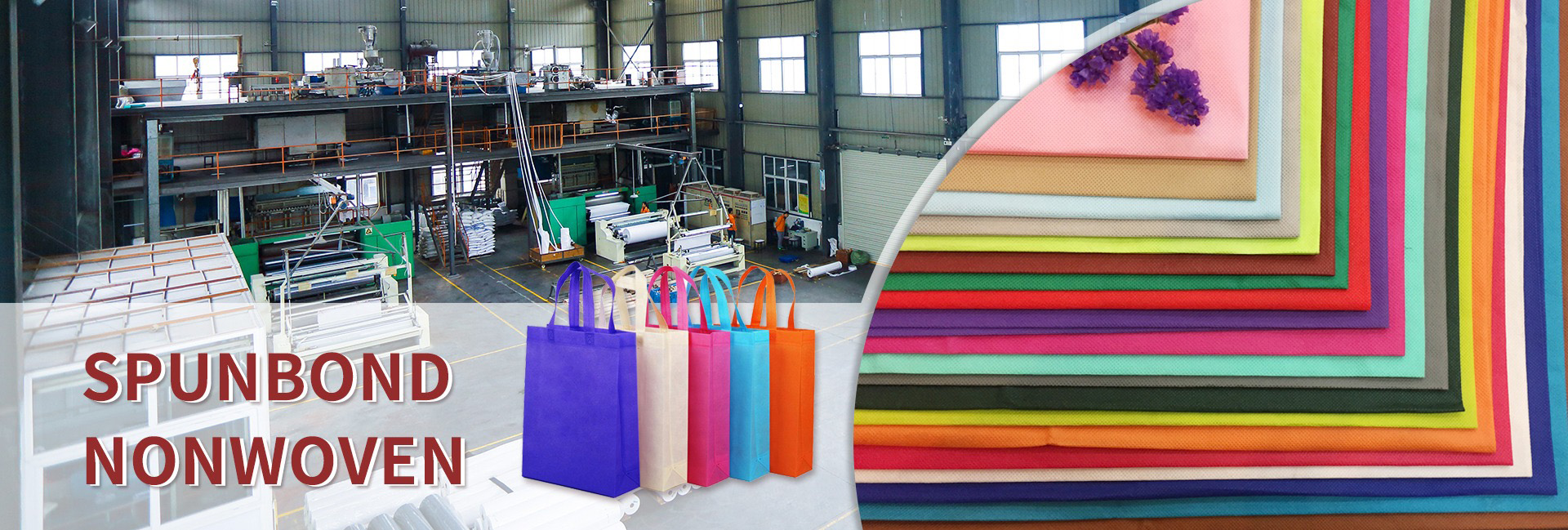
In the production of polyester spunbond hot-rolled nonwoven fabric, “weight uniformity” is one of the core indicators that determine product quality and has been a long-standing pain point in the industry. The so-called weight fluctuation refers to the deviation of the weight per unit area of non-woven fabric. Seemingly small weight differences not only lead to uneven thickness and disorderly patterns on the fabric surface, but also directly affect the key properties of the product such as tensile strength, breathability, and barrier properties. In severe cases, it can cause a large number of unqualified products, increase production costs, and even affect the production stability of downstream customers.
In the past, the conventional polyester spunbond hot rolling process was affected by multiple factors such as raw materials, equipment, and operation, and the weight fluctuation range was often above ± 5%, which was difficult to meet the strict requirements of high-end hygiene products, precision filtration, high-end packaging, and other scenarios. Nowadays, with the continuous innovation of process technology, the polyester spunbond hot rolling process has achieved a leap from “passive control of fluctuations” to “active pursuit of uniformity”, controlling the weight fluctuation within ± 2%, achieving the ultimate uniformity of the fabric surface, and completely solving this industry problem. Today, let’s delve into the process innovation centered around “weight uniformity” and see what the core technological breakthrough behind it is.
Let’s first understand why weight fluctuations have become a major challenge in the industry?
To understand the value of technological innovation, it is first necessary to clarify: where does the weight fluctuation come from in the conventional polyester spunbond hot rolling process? After practical experience in the industry, the core causes are mainly concentrated in the four major links of raw materials, spinning, web forming, and hot rolling, which are interrelated. Any deviation in any link will lead to weight fluctuations.
Firstly, the control of raw materials is not in place. The inconsistent moisture content, particle uniformity, and intrinsic viscosity of polyester chips can cause fluctuations in the viscosity of the molten material after melting, which in turn affects the stability of the spinning amount. For example, if the moisture content of the chips is too high, it can cause bubbles in the molten material, resulting in “broken” and “multiple” threads during spinning, directly causing uneven weight distribution on the fabric surface; The uneven size of sliced particles can affect the uniformity of screw extrusion, further exacerbating weight fluctuations.
Secondly, the spinning process parameters are unstable. Spinning temperature, spinning speed, and stretching airflow pressure are key parameters that affect the amount of spinning. In conventional processes, these parameters are mostly manually adjusted and are easily affected by environmental temperature and equipment operation losses, resulting in small deviations. For example, fluctuations in the pressure of the stretching airflow can lead to uneven fiber stretching, with some fibers being too coarse and others too fine, resulting in locally high or low weight after laying the mesh.
Thirdly, the network is unevenly laid in the process of forming the network. Web formation is the core process of fiber formation on the fabric surface. Insufficient matching between the swinging speed of conventional web laying equipment and the running speed of the mesh belt, or adhesion of fiber bundles to the mesh curtain, can lead to uneven distribution of fibers on the mesh belt, resulting in “thin web” and “thick clumps”, directly reflected as weight fluctuations. In addition, the unstable tension of the mesh belt can lead to uneven stretching of the fabric surface, further amplifying the weight deviation.
Fourthly, the pressure and temperature in the hot rolling process are uneven. The core function of hot rolling is to bond and shape the fiber web. If the temperature distribution of the hot rolling mill is uneven and the line pressure fluctuates, it will cause different degrees of local melting on the fabric surface – the fibers in the area of excessive melting shrink, and the weight appears to be higher; The fibers in the area with insufficient melting are loose and the weight is low, resulting in weight fluctuations, as well as problems such as blurred rolling points and uneven fabric surface.
More importantly, in conventional processes, each link is independent of each other and lacks linkage regulation, often resulting in a situation of “treating the head when the head hurts and treating the foot when the foot hurts”: solving the fluctuation of spinning parameters, but also causing uneven mesh laying; Adjusting the mesh laying speed has caused deviations in the hot rolling process, making it difficult to fundamentally solve the problem of weight fluctuations.
Four core breakthroughs to achieve “ultimate uniformity” in weight and weight
The innovation of polyester spunbond hot rolling process this time is not just an improvement in a single link, but a full process closed-loop system of “precise control of raw materials+intelligent control of spinning+uniform web laying+hot rolling linkage adaptation” has been constructed. Through breakthroughs in four core technologies, weight fluctuations are eliminated from the source, achieving a qualitative leap in fabric uniformity.
Breakthrough 1: Intelligentization of raw material pretreatment, laying a solid foundation for uniformity. The innovative process introduces an intelligent raw material pretreatment system, completely changing the traditional “extensive” raw material control mode. Firstly, the polyester chips are graded and screened to eliminate chips with uneven particle size and excessive impurities, ensuring that the uniformity error of the chip particles is ≤ 0.1mm. Secondly, a closed-loop drying system is used to accurately control the moisture content of the chips within 0.003%, avoiding melt fluctuations caused by moisture; At the same time, real-time monitoring of slice characteristic viscosity is carried out through an online detection system. Once there is a deviation, the raw material ratio is automatically adjusted to ensure stable melt viscosity and reduce fluctuations in spray volume from the source.
Breakthrough 2: Digital control of spinning process to achieve precise and controllable spinning. Abandoning the traditional manual adjustment mode, an intelligent spinning control system is adopted to digitize and visualize parameters such as spinning temperature, spinning speed, and stretching airflow pressure, and monitor and automatically regulate them in real time. For example, by using an infrared thermometer to monitor the temperature of each section of the screw in real time, the error is controlled within ± 1 ℃ to avoid changes in melt viscosity caused by temperature fluctuations; Using frequency conversion to control the pressure of the stretching airflow, the pressure fluctuation is controlled within ± 0.1 bar to ensure uniform fiber stretching and stable spinning volume; At the same time, the design of the spinneret is optimized by using a precision microporous spinneret with an aperture error of ≤ 0.01mm, ensuring consistent fineness and flow rate of each fiber, and eliminating the source of weight fluctuations from the spinning process.
Breakthrough 3: Optimization of the linkage of the networking process to achieve uniform fiber distribution. The reformed mesh forming process adopts a dual row intelligent wire swinging system and mesh belt tension closed-loop control technology, completely solving the problem of uneven mesh laying. The double row spinning system can achieve precise adjustment of spinning speed and amplitude, with a spinning frequency of up to 300 times per minute, ensuring that fibers are evenly spread on the mesh belt and avoiding the phenomenon of “thin mesh” and “thick clumps”; At the same time, the tension of the mesh belt is intelligently regulated, with real-time monitoring of the running speed and tension of the mesh belt, automatic matching of the spinning speed, ensuring smooth operation of the mesh belt with tension fluctuations ≤ 0.5N, and avoiding weight deviation caused by uneven stretching of the fabric surface. In addition, a mesh belt cleaning system has been added to clean the fiber bundles on the mesh curtain in real time, further improving the uniformity of mesh laying.
Breakthrough 4: Linkage adaptation of hot rolling process, locking in weight uniformity. The core of the innovation in the hot rolling process is “linkage adaptation”, which links and controls the hot rolling temperature, line pressure, spinning and web forming parameters to form a closed loop. Adopting zone temperature controlled hot rolling rolls, real-time monitoring of the temperature in each area of the roll surface through embedded temperature sensors, ensuring uniform temperature distribution on the roll surface with an error of ≤ 2 ℃; The line pressure is controlled by hydraulic intelligent regulation, and the pressure is automatically adjusted according to the weight of the formed network. The fluctuation is controlled within ± 5N to avoid weight deviation caused by excessive or insufficient local pressure; At the same time, optimize the matching degree between the speed of the hot rolling mill and the running speed of the fabric surface, ensuring that the pressing time and pressure in each area of the fabric surface are consistent, which not only ensures firm adhesion but also avoids weight fluctuations caused by uneven pressing.
From “Qualified” to “High Quality”, Empowering the Upgrading of the Entire Industry Chain
This process innovation centered around “uniform weight distribution” not only solves industry pain points, but also upgrades the quality of polyester spunbond hot-rolled non-woven fabric products, bringing multiple values to the entire industry chain and promoting the transformation of the industry from “scale expansion” to “quality improvement”.
For production enterprises, controlling weight fluctuations within ± 2% significantly reduces the rate of non-conforming products. According to industry measurement data, after process innovation, the non-conforming product rate has decreased from 8% -10% to 1% -2%, reducing raw material waste by more than 30% annually and significantly reducing production costs; At the same time, the intelligent regulation of the entire process reduces manual operations, improves production efficiency, and increases the production capacity of a single production line by 20%, achieving the production goal of “reducing costs and increasing efficiency”.
For downstream industries, polyester spunbond hot-rolled non-woven fabric with uniform weight has more stable performance and reliable quality, completely solving many problems in downstream production. For example, in the field of high-end hygiene products, fabrics with uniform weight have a finer texture and more even breathability, enhancing the product’s user experience; In the field of precision filtration, uniform weight ensures stable filtration efficiency and avoids filtering loopholes caused by local weight deviation; In the high-end packaging field, consistent thickness of fabric ensures better printing and composite effects, enhancing packaging aesthetics and practicality.
For the development of the industry, this technological innovation has promoted the upgrading of polyester spunbond hot rolling technology, broken the industry’s perception that “weight fluctuations are difficult to control”, and provided new ideas for technological innovation in the non-woven fabric industry. At the same time, the high-end products with uniform weight have broken the technological monopoly of similar foreign products, enhanced the core competitiveness of China’s non-woven fabric products, and promoted China’s leap from a “non-woven fabric country” to a “non-woven fabric power”.
Continuous iteration, pursuit of ultimate uniformity
With the increasingly stringent requirements for product quality in downstream industries, the standard for weight uniformity will continue to improve, moving from the current ± 2% to ± 1% or even higher precision. In the future, the innovation of polyester spunbond hot rolling process will develop towards the direction of “smarter, more accurate, and more efficient” – by introducing AI intelligent control system, the entire process parameters can be autonomously learned and optimized, further improving the uniformity of weight; Combining big data analysis to predict in advance the impact of factors such as raw materials, equipment, and environment on weight, achieving “pre prevention”; At the same time, combined with the concept of green production, while improving uniformity, further reducing energy consumption and pollution, achieving a dual improvement in quality and environmental protection.
From “weight fluctuation” to “extreme uniformity”, it may seem like an improvement in just one indicator, but behind it is a comprehensive innovation in the entire polyester spunbond hot rolling process, and a vivid manifestation of the non-woven fabric industry’s pursuit of high-quality development. This innovation not only solves the pain points of the industry, but also empowers the upgrading of the entire industry chain. In the future, with the continuous iteration of technology, it will surely promote the high-quality development of the polyester spunbond hot-rolled non-woven fabric industry and unlock more high-end application new scenarios.
Dongguan Liansheng Non woven Technology Co., Ltd. was established in May 2020. It is a large-scale non-woven fabric production enterprise integrating research and development, production, and sales. It can produce various colors of PP spunbond non-woven fabrics with a width of less than 3.2 meters from 9 grams to 300 grams.
Post time: Apr-03-2026