
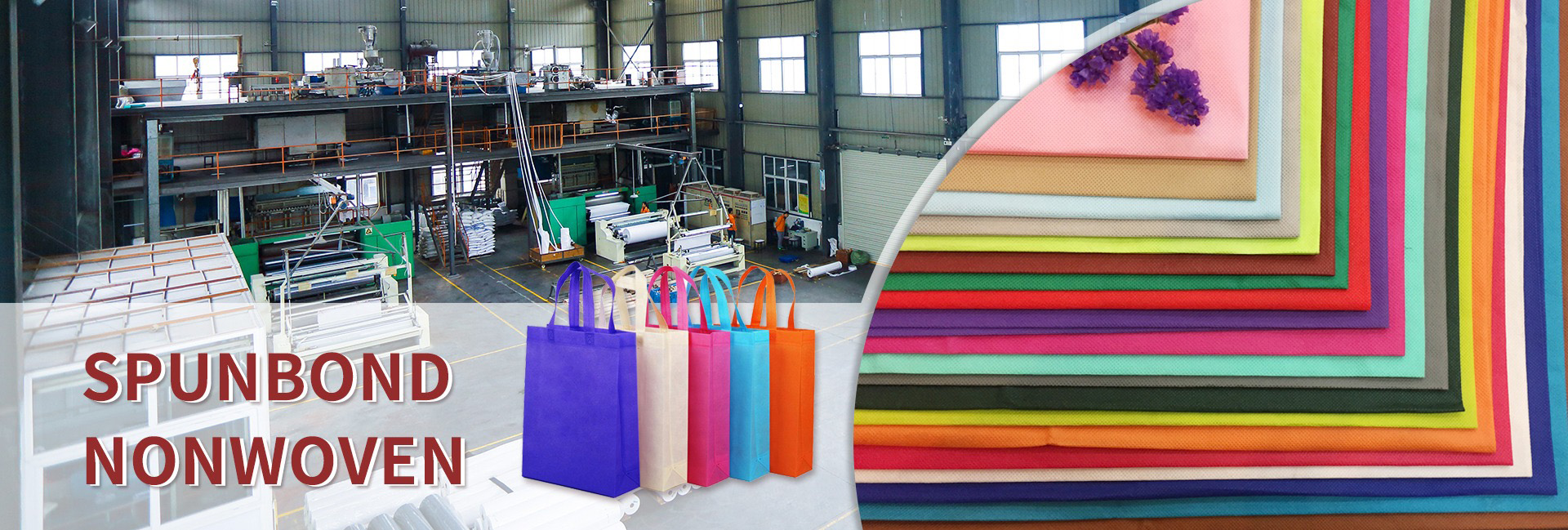
In the field of non-woven materials, there has always been an industry pain point: high-strength materials are often hard, have poor elasticity, and deform easily when pulled; Elastic materials have insufficient strength and are prone to damage, making it difficult to meet the needs of complex scenarios. The emergence of two-component polyester spunbond hot-rolled fabric has completely broken this “dilemma”. With innovative two-component composite technology, it has achieved a two-way breakthrough in elasticity and strength, becoming a “potential stock” in the current high-end non-woven field, quietly penetrating into all aspects of our lives, industries, and medical care.
Decrypting the “combination of rigidity and flexibility”: two-component structure is the core password
Many people may be unfamiliar with “two-component polyester spunbond hot-rolled fabric”, but in fact, it has already been integrated into daily life – it can be found in medical surgical gowns, baby diapers, car interiors, and even roadbed reinforcement materials in construction projects. Its core competitiveness lies in the combination of rigidity and flexibility, which can be as tough and durable as ordinary polyester fabric, and as flexible and resilient as elastic fabric. All of this stems from its unique raw material design and production process.
The so-called “two-component”, in layman’s terms, refers to the fusion of two different performance polyester raw materials through composite spinning technology, forming composite structures such as “skin core type” and “parallel type” long filament fibers, which are then spun and bonded into a web, hot-rolled and solidified, and finally made into non woven fabric. Unlike traditional single component spunbond fabrics, this two-component structure achieves “complementary advantages”: the core layer uses high-strength polyester to support the “skeleton” of the material, ensuring its load-bearing capacity and fracture resistance; The cortex is made of low melting point, high elasticity polyester derivatives, which give the material softness and resilience, allowing it to “stretch and retract”.
The precise hot rolling process maximizes the combination of rigidity and flexibility. Unlike traditional processes that require the addition of chemical adhesives for bonding, two-component polyester spunbond hot-rolled fabrics are produced using a one-step hot rolling method. The composite fiber web is directly fed into a hot roll to achieve thermal bonding between fibers at a specific temperature and pressure, without the need for any chemical additives. This approach is environmentally friendly and maximizes the retention of the fiber’s own properties. In production, by precisely controlling the hot rolling temperature, pressure, and stretching speed (up to 5000m/min), the number of bonding points between fibers is controlled to avoid problems such as “too tight and stiff bonding” and “too loose and easy to loosen bonding”, ultimately achieving a perfect balance between elasticity and strength.
Double directional compaction of ordinary materials with strength and elasticity
From a performance perspective, the advantages of two-component polyester spunbond fabric are visible to the naked eye and verifiable by data. In terms of strength, its longitudinal fracture strength can reach over 42N/5cm, and its transverse strength is not less than 30N/5cm, far superior to ordinary elastic non-woven fabrics. Moreover, it has outstanding tear and creep resistance, and will not easily deform under long-term stress. Its service life is significantly extended compared to single component products.
In terms of elasticity, the longitudinal and transverse elongation at break is not less than 10%, and high-end products can reach more than 18%. After repeated stretching, it can quickly rebound, solving the pain points of “hard, brittle, and easy to break” in traditional high-strength spunbond fabrics. In addition, its weight (20-150g/m ²) and width (1.6m, 2.4m, etc.) can be flexibly adjusted, with a smooth surface, breathable and breathable, suitable for diverse needs in different scenarios. Whether it is an industrial scene that requires load-bearing or a medical scene that needs to fit the human body, it can easily handle it.
Multi scenario empowerment: an all-around player from daily life to industry
With this “all-around advantage”, the application scenarios of two-component polyester spunbond hot-rolled fabric continue to expand, covering multiple core fields such as medical, industrial, construction, and health, becoming a true “versatile”. In the field of healthcare, it is an ideal protective material – used for surgical gowns and caps, which can resist pulling and damage, fit the contours of the human body, and improve the comfort of medical staff’s wearing; Used for the surface or flow guiding layer of diapers and sanitary napkins, it balances breathability and deformation resistance, providing a better user experience.
In the fields of industry and construction, its “toughness” characteristics are fully demonstrated. As a filtering material and cable wrap, it can resist pulling and wear in industrial environments; As a geotechnical material, it can be used for roadbed reinforcement, resisting soil pressure without deformation, and effectively avoiding pavement cracking. The related products developed by companies such as Dalian Huayang have also filled the gap in high-end industrial textiles in China, which can replace imports and be applied in high-end waterproofing membranes, automotive interiors, and other fields.
It also performs well in the fields of packaging and home textiles. As a high-end packaging material, it not only ensures packaging safety but also has a certain degree of elasticity, enhancing product texture; As an anti velvet lining and curtain fabric, it is durable and soft, balancing practicality and aesthetics. With technological upgrades, domestic enterprises such as Anhui Jinchun and Ji’an Sanjiang have achieved large-scale production, with products benchmarking international advanced levels and obvious cost-effectiveness advantages, gradually breaking the monopoly of foreign investment in the high-end market.
Future is promising: Technological innovation unlocks more possibilities
Nowadays, with the continuous upgrading of non-woven technology and the promotion of the “dual carbon” policy, two-component polyester spunbond hot-rolled fabrics are developing towards a greener, more efficient, and higher end direction. By optimizing processes, reducing energy consumption, and improving performance, enterprises ensure that their products maintain a balance between elasticity and strength while also meeting environmental protection requirements.
In the future, with the improvement of raw material formulas and the precision of processes, it will also break through more performance boundaries and achieve new breakthroughs in fine filtration, high-end medical, automotive lightweighting and other scenarios. The rise of two-component polyester spunbond hot-rolled fabrics, from breaking industry pain points to empowering multiple fields, is driven by the power of technological innovation. It redefines the standards of high-end non-woven materials with its characteristic of “combining rigidity and flexibility”, and also shows us the broad prospects of the non-woven industry.
Dongguan Liansheng Non woven Technology Co., Ltd. was established in May 2020. It is a large-scale non-woven fabric production enterprise integrating research and development, production, and sales. It can produce various colors of PP spunbond non-woven fabrics with a width of less than 3.2 meters from 9 grams to 300 grams.
Post time: Apr-04-2026