
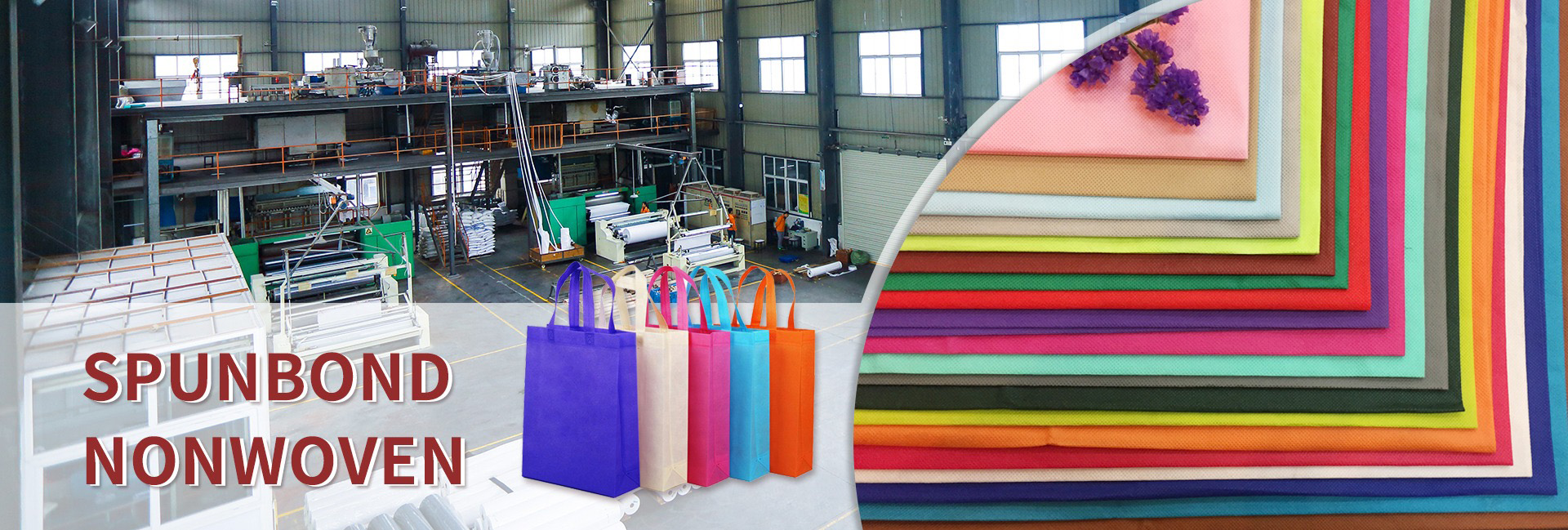
Say goodbye to noisy workshops and heavy manual labor. Nowadays, PP non-woven fabric production has long bid farewell to the era of “competing for manpower”. Entering the PP non-woven fabric workshop after intelligent transformation, the scene in front of us subverts many people’s inherent cognition: in the unmanned raw material area, robots accurately grasp raw materials and automatically feed them; Next to the high-speed production line, the AI vision system scans the fabric in real-time and identifies small defects in seconds; In the control room, a worker sits in front of the central control screen and can easily monitor the entire operation of three production lines with just a click of the mouse, achieving an efficient production mode of “one person managing three lines”.
Once, traditional PP non-woven fabric workshops were plagued by three major problems: “labor shortage”, “low efficiency”, and “strict quality inspection” – raw material loading relied on manual handling, which not only had high labor intensity, but also easily caused problems such as uneven feeding and impurities; The quality inspection of fabric relies on manual visual inspection, which not only has low efficiency but also leads to missed or false detections due to fatigue; A production line requires at least 3-4 workers to be on duty, resulting in high labor costs. And intelligent transformation has completely solved these pain points, allowing PP non-woven fabric production to enter a new stage of “efficiency, precision, and labor-saving”. Today, we will enter this intelligent workshop to see how robots and AI empower production and achieve the industrial miracle of “one person managing three lines”.
Robot feeding, bidding farewell to manual handling, 24-hour non-stop operation
In the raw material area of the intelligent PP non-woven fabric workshop, there are no figures of workers bending over to handle and feed materials. Instead, there are flexible column type unpacking robots and six axis articulated robots that work together to complete the full process automation operation from raw material unpacking, grabbing to feeding, completely freeing up manual labor.
Before the renovation, feeding raw materials was one of the most arduous processes. PP polypropylene particles are packed in thick bags, each weighing up to 50 kilograms. Workers need to manually transport the bags, unpack them, and then pour the particles into the silo. This not only increases labor intensity, but also makes the workshop environment above 38 ℃ unbearable for frontline workers. It is also prone to problems such as uneven feeding, bag residue, and impurity mixing, which affect the subsequent melt plasticization and fabric quality.
After the intelligent transformation, all of these processes are completed by robots. The column type unpacking robot is equipped with a 3D vision system, which can automatically recognize the position of the material bag, accurately grab the material bag and complete the unpacking. With the help of automatic conveying equipment, PP particles are accurately fed into the silo. The sensors in the silo monitor the material level in real time and automatically stop when the feeding is full, avoiding waste and overflow. For production needs that require mixing ingredients, robots can accurately control the ratio of different raw materials, and work with automatic mixing systems to ensure uniform mixing of raw materials. The data is uploaded in real-time to the workshop control system for traceability.
It is worth mentioning that these feeding robots can operate continuously for 24 hours without rest or exhaustion, and can also avoid errors caused by manual operation. Not only does it significantly reduce the labor intensity of workers, but it also increases feeding efficiency by more than three times. Before the transformation, the feeding process of one production line required two workers to work in shifts. After the transformation, one robot can meet the feeding needs of two production lines, laying the foundation for “one person managing three lines”.
Full coverage of AI quality inspection, defect recognition in seconds, with a pass rate soaring to 98.5%
The uniformity and defect situation of PP non-woven fabric directly determine the product quality, especially for medical and high-end packaging non-woven fabrics, which have extremely strict quality inspection requirements. Traditional workshops rely solely on manual visual inspection, which not only requires a large number of quality inspectors, but also has many drawbacks – the human eye is prone to fatigue, with a leakage rate of up to 35%, and cannot accurately distinguish more than 10 subtle defects such as “mosquitoes, black spots, and oil stains”, which can easily lead to unqualified products entering the market and causing customer complaints.
After the intelligent transformation, the AI visual quality inspection system has become the “golden eye” of the workshop, completely replacing manual quality inspection and realizing the full process and high-precision detection of fabric defects. This system consists of an 8K line scanning camera, a high brightness water-cooled linear light source, and an AI deep learning algorithm. It can adapt to a high-speed production line of 600m/min and capture every detail of the fabric in real time, with a response speed as fast as 0.01 seconds.
The core advantages of AI quality inspection system lie in “precision” and “efficiency”. It uses deep learning models and is trained with a large number of samples to accurately identify various defects such as holes, nodules, stains, and uneven thickness. The classification accuracy exceeds 99%, and the missed detection rate drops to below 0.3%, which is much more accurate than manual quality inspection. During the inspection process, the system will generate a “defect map” in real time, clearly marking the location, size, and type of each defect. At the same time, it will be linked with the rewinding machine. When the rewinding reaches the defect position, the system will automatically control the equipment to slow down and light up an alarm, making it convenient for workers to quickly review and handle, and avoiding unqualified products from flowing into the next process.
In addition, the AI quality inspection system can automatically collect defect data, generate visual quality reports, and provide data support for optimizing production processes and improving product quality in the workshop, making production management more targeted. Before the renovation, a production line required 2-3 quality inspectors to take turns inspecting. After the renovation, the AI system is on duty throughout the entire process without manual intervention, which not only saves labor costs but also increases the product qualification rate from 90% to 98.5%, significantly reducing raw material waste.
Integrated central control system, one person managing three lines, doubling efficiency
If robot feeding and AI quality inspection are the “hands, feet” and “eyes” of intelligent workshops, then the integrated central control system is the “brain” of the workshop and the core key to achieving “one person managing three lines”. After the intelligent transformation, the entire workshop’s production line, robots, quality inspection equipment, and winding and slitting equipment are all connected to the central control system, achieving centralized control and data interconnection of the entire production process.
In the central control room of the workshop, a worker sitting in front of the central control screen can monitor the real-time operation status of three production lines – from raw material feeding, melt plasticization, spinning into a mesh, to thermal bonding, post-treatment, winding and slitting. The parameters and equipment operation status of each link are clearly visible. The central control system adopts industrial grade PLC as the core controller, supports OPC UA protocol, and can achieve seamless collaboration between devices. Workers can adjust production parameters and issue operation instructions with just a click of the mouse, without the need to manually operate on the production line.
For example, when a production line experiences a shortage of raw materials, the central control screen will automatically sound an alarm. Workers only need to issue instructions, and the robot will immediately start the replenishment process; When the AI quality inspection system detects serious defects in the fabric, the system will automatically pause the production process and remind workers to handle it in a timely manner; In the winding and slitting process, the fully automatic slitting machine is equipped with a high-precision encoder, which can achieve zero error slitting. Workers only need to call the pre stored process template to complete specification switching within 30 seconds, without the need for repeated parameter debugging.
Before the renovation, a PP non-woven fabric production line required 3-4 workers to be on duty, responsible for loading, inspecting, adjusting parameters, winding, and other work. Three production lines required at least 10 workers; After the renovation, relying on the integrated central control system, one worker can take care of monitoring and operating three production lines, which not only significantly reduces the number of workers, but also improves production efficiency – the daily output of the three production lines has increased by 40% compared to before the renovation, and downtime has decreased by 67%, truly achieving the goal of “reducing manpower, improving quality, and increasing efficiency”.
Intelligent transformation, and these ‘hidden advantages’
In addition to the core highlights of robot feeding, AI quality inspection, and one person managing three lines, the intelligent transformation of the PP non-woven fabric workshop has also brought many hidden advantages, further enhancing the core competitiveness of the enterprise.
Firstly, production is more stable. The operational accuracy of intelligent devices is much higher than that of manual labor, and they can accurately control key parameters such as temperature, pressure, and feeding amount, avoiding errors caused by manual operation, ensuring consistent quality of non-woven fabrics in each batch, and reducing the production of unqualified products. For example, the automatic starch and glue adding system can achieve automatic powder addition, water addition, stirring, and temperature rise, avoiding quality instability caused by manual mixing errors. The data is uploaded to the system in real time, achieving full process traceability.
The second is a significant reduction in costs. On the one hand, it reduces the number of workers and lowers labor costs; On the other hand, AI quality inspection reduces raw material waste, robot feeding avoids material loss, and fully automatic winding and packaging equipment reduces manual packaging errors. Overall, the production cost of the workshop has been reduced by more than 25% compared to before the renovation, and the annual labor cost savings for a single production line can reach 420000 yuan.
The third is more efficient management. The central control system can collect production data, equipment operation data, and quality inspection data in real time, generate various statistical reports, and the management can grasp the production situation of the workshop in real time through the mobile phone or central control screen. Without going deep into the workshop for investigation, production decisions can be made quickly. At the same time, the traceability of the entire production process is achieved, which facilitates lean management for enterprises and shortens the process optimization cycle by 30%.
Fourthly, safety is more guaranteed. Intelligent devices have replaced manual completion of high-intensity and high-risk operations, such as high-altitude winding and heavy material handling, reducing the occurrence of work-related accidents; The sensors in the workshop monitor temperature, humidity, dust and other indicators in real time. Once an abnormality occurs, the system will automatically alarm and take emergency measures to ensure production safety in the workshop.
Intelligent transformation, rewriting the production pattern of PP non-woven fabric
The intelligent transformation of PP non-woven fabric workshop, from manual handling, visual inspection, multi person duty, to robot feeding, AI quality inspection, and one person managing three lines, is not only an upgrade of production equipment, but also a change in production mode, completely rewriting the traditional non-woven fabric production pattern of “high labor, low efficiency, and large quality fluctuations”.
Robot feeding liberates manpower, AI quality inspection ensures quality, and the central control system realizes efficient management. The three work together to make PP non-woven fabric production more efficient, accurate, and worry free. For non-woven fabric production enterprises, intelligent transformation can not only solve the problems of labor shortage and high costs, but also improve product quality and core competitiveness, adapt to the needs of high-quality development in the industry – enterprises such as Tiandingfeng and Wuhu Youpai have not only significantly increased production capacity through intelligent transformation, but also achieved steady improvement in product quality, becoming industry benchmarks.
In the future, with the continuous advancement of technology, the intelligence level of PP non-woven fabric workshop will continue to improve, and robots AI、 The Internet of Things and other technologies will be deeply integrated to achieve the ultimate goal of “unmanned workshop” and “black light production”. And this intelligent transformation will also drive the entire non-woven fabric industry towards more efficient, green, and high-quality development, allowing small PP non-woven fabrics to play a greater role in more fields.
Dongguan Liansheng Non woven Technology Co., Ltd. was established in May 2020. It is a large-scale non-woven fabric production enterprise integrating research and development, production, and sales. It can produce various colors of PP spunbond non-woven fabrics with a width of less than 3.2 meters from 9 grams to 300 grams.
Post time: May-13-2026