
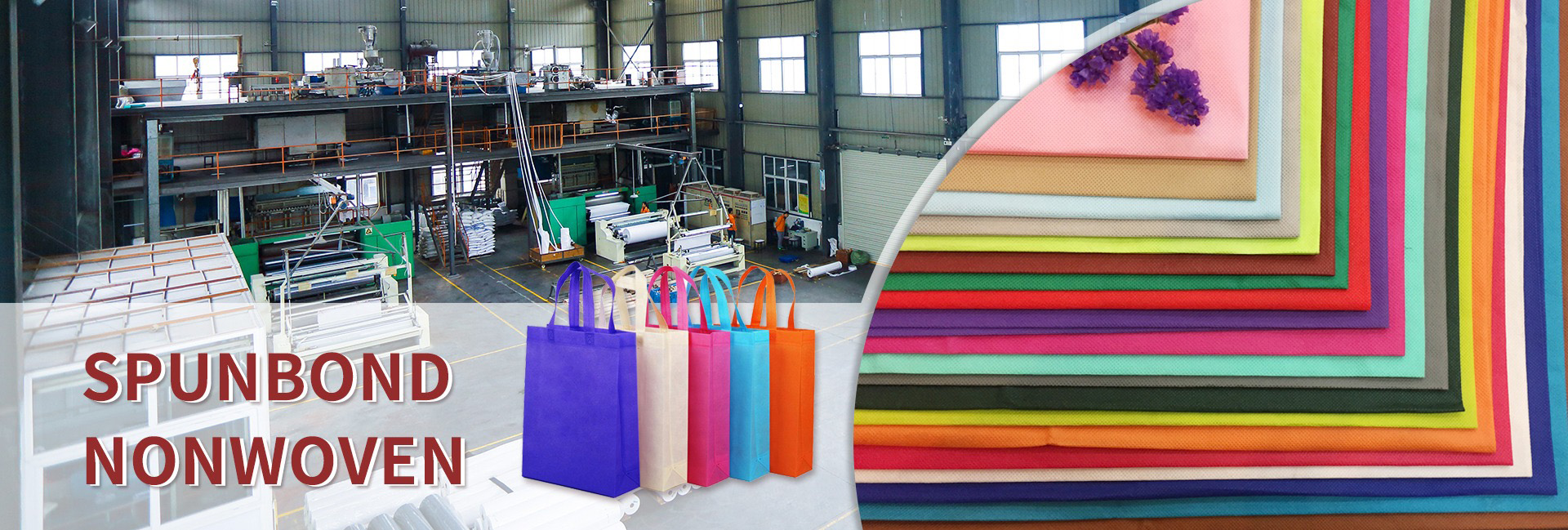
Okay, the hydrophilic modification and post-treatment technology of polyester spunbond non-woven fabric is the key to its application in fields such as medical and health care, wiping cloth, battery separator, etc. In recent years, the technology in this field has developed rapidly, evolving from basic surface treatment to permanent, multifunctional, and environmentally friendly directions.Below is a detailed analysis of its technological progress.
Core challenge: Why does polyester (PET) need hydrophilic modification?
Polyester fibers themselves have high hydrophobicity due to the lack of hydrophilic groups (such as – OH, – COOH) in their molecular chains and high crystallinity. This leads to:
Difficult to penetrate liquids: When used as sanitary materials, it can hinder the rapid absorption and diffusion of blood, tissue fluids, etc., causing discomfort during use.Difficult to dye and organize: subsequent processing is challenging.Poor anti-static properties: easy to adsorb dust.Therefore, hydrophilic modification of polyester spunbond nonwoven fabric is the primary step in endowing it with functional applications.
Progress in hydrophilic modification technology route
The technology roadmap is mainly divided into two categories: online modification and offline post-processing, and their combination is the current mainstream trend.
(1) Online modification technology: integrated with production processes
Online modification is the simultaneous imparting of hydrophilicity during the production process of spunbond nonwoven fabrics, and its durability is usually better than offline finishing.Hydrophilic masterbatch addition method (blend spinning method).Technical principle: Mix hydrophilic modifier (usually polyether polymer) with PET slices at high concentration to make masterbatch. Before melt spinning, the masterbatch is mixed with PET slices in a certain proportion (usually 1.5% -4%) and spun by screw extrusion.
Progress and advantages:
Permanent hydrophilicity: The hydrophilic agent is encapsulated inside the fiber and slowly migrates to the surface during use, making it resistant to multiple water washes and highly durable.Uniformity: Hydrophilic agents are evenly distributed on the fiber cross-section and have stable performance.Mainstream direction: This is currently the most mainstream and reliable technology for large-scale production of medical and health spunbond fabrics. The new generation of hydrophilic masterbatch has a lower addition ratio, faster hydrophilic effect (instantaneous hydrophilicity), and better compatibility with other functions (such as antibacterial).
Surface graft polymerization method
Technical principle: During or after the fiber forming process, hydrophilic monomers (such as acrylic acid) are grafted onto PET polymer chains through triggering methods such as ultraviolet radiation, electron beam, or plasma.
Progress and advantages:True chemical modification: forming strong covalent bonds with extremely long-lasting hydrophilicity.Environmental Protection: No need for chemical finishing agents, no wastewater issues.Challenge: Large equipment investment, high cost, and complex process control. Currently, it is mainly used for high-end, high value-added products and has not yet been widely popularized.
Copolymerization method
Technical principle: In the PET polymerization stage, a third monomer containing hydrophilic groups (such as polyethylene glycol) is introduced to synthesize inherently hydrophilic copolyesters.
Progress: It can fundamentally change the properties of PET, but the technical threshold is extremely high, the cost is high, and it is only mastered by a few large chemical enterprises, so its application is not widespread.
(2) Offline post-processing technology: performed on finished fabric products.Offline organization has high flexibility and is suitable for small batch and multi variety production, making it an important way to achieve functional integration.
Padding method
Technical principle: The non-woven fabric is passed through a rolling groove filled with hydrophilic finishing agent working fluid, fully immersed, and then excess liquid is pressed off by a rolling mill, followed by drying and shaping.
Progress of finishing agents:
First generation: Non ionic surfactants. Low cost, but hydrophilic and not resistant to water washing, it is disposable.Second generation: reactive hydrophilic finishing agent. The molecule contains reactive groups (such as epoxy groups) that can bond with groups on the surface of PET fibers, significantly improving washing resistance.Third generation: High molecular weight hydrophilic polymers (such as polyurethane, polyacrylate hydrophilic products). It can form a strong hydrophilic film on the surface of fibers, with better durability and a soft touch.
Advantages: Universal equipment, mature technology, and strong flexibility.
Spraying method
Technical principle: Use a nozzle to evenly spray hydrophilic finishing agent onto the surface of non-woven fabric.
Progress: Widely used in post-processing of thicker materials such as SMS, with much less water consumption than the immersion rolling method, more energy-efficient and environmentally friendly. The key lies in the uniformity control of spraying, and the new ultrasonic atomizing nozzle can greatly improve uniformity and efficiency.
Foam Finishing
Technical principle: Mix hydrophilic finishing agent, foaming agent, stabilizer, etc. with air to make stable foam, and then apply it evenly to non-woven fabrics.
Progress and advantages:
Energy saving and environmental protection: The liquid carrying rate is extremely low (20% -40%), which can save more than 50% of drying energy and reduce the amount of chemicals used.
Good uniformity: Especially suitable for products with high weight and large thickness.
Future direction: It is an important development direction of green manufacturing. With the maturity of foam stability control technology, it is applied more and more widely.
Technological development trends and frontiers
The balance between persistence and transience: The market requires materials that not only have a fast initial hydrophilic speed (instant penetration), but also can withstand multiple disinfections (such as multiple water washes and gamma ray disinfection of medical supplies). The development of modifiers with both characteristics is a key focus of research and development.Multi functional composite hydrophilic finishing: Hydrophilic finishing is no longer a single function, often combined with antibacterial, anti-static, flame retardant and other functions.
For example, hydrophilic antibacterial integrated finishing achieves multifunctionality in one step by adding antibacterial agents such as silver ions and quaternary ammonium salts to hydrophilic finishing agents.
Environmental Protection and Greening:
Biobased hydrophilic agent: Developing hydrophilic finishing agents using natural polysaccharides (such as chitosan), plant extracts, and other raw materials.Low chemical consumption technology: such as foam finishing, precise spraying, etc.Fluorine free waterproofing transition: In fields that require both waterproof and breathable functions (such as medical protective clothing), the use of environmentally friendly fluorine free waterproofing agents in combination with hydrophilic agents is a clear trend.
Plasma processing technology:
This is a dry physical treatment method that does not require water or chemicals. By bombarding the surface of non-woven fabric with low-temperature plasma, both hydrophilic groups can be introduced and the surface can be etched to increase roughness, synergistically enhancing hydrophilicity.
Advantages: Absolute environmental protection and uniform effect.
Challenge: Currently, most of the production is intermittent, making it difficult to match the processing speed with continuous production lines and resulting in high costs. But it is a cutting-edge technology with great potential for the future.
Conclusion
Currently, “online hydrophilic masterbatch modification” has become the gold standard for high-end medical and health polyester spunbond nonwoven fabrics due to its excellent durability. Offline organization technology is rapidly developing towards green, energy-saving, and multifunctional composite directions, providing flexible and diverse solutions for product differentiation. In the future, the two are not substitutes, but complement each other. For example, the combination technology path will become the key to develop the next generation of high-performance non-woven fabrics by endowing the substrate with permanent hydrophilicity through online master batch, and then endowing it with antibacterial function through offline foam finishing.
Dongguan Liansheng Non woven Technology Co., Ltd. was established in May 2020. It is a large-scale non-woven fabric production enterprise integrating research and development, production, and sales. It can produce various colors of PP spunbond non-woven fabrics with a width of less than 3.2 meters from 9 grams to 300 grams.
Post time: Sep-22-2025