
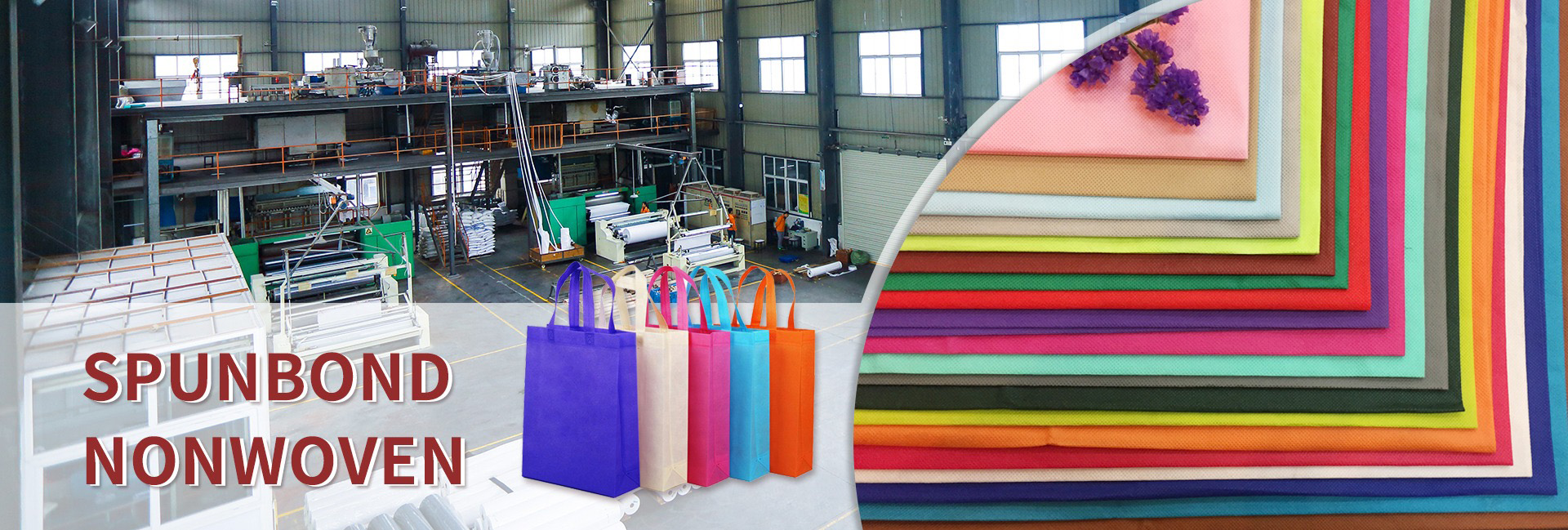
Geotextile is the core protective material for infrastructure construction such as road engineering and water conservancy engineering, undertaking key functions such as reinforcement, drainage, filtration, and isolation. Spunbond non-woven fabric, with its advantages of large-scale production, controllable performance parameters, and wide adaptability to working conditions, occupies more than 60% of the geotextile market share and has become the absolute “main force”. Among them, road reinforcement and drainage filtration are its most core application scenarios.
Compared with materials such as woven geotextiles, knitted geotextiles, and traditional gravel cushion layers, spunbond non-woven fabrics achieve engineering value that is difficult to replace with traditional materials due to their unique advantages of “balancing strength and flexibility, coordinating filtration and drainage, and balancing cost and efficiency”. They not only solve the problems of settlement and cracking in road construction, but also ensure the stable operation of drainage systems, laying a long-term protective line for infrastructure projects. The following is a detailed analysis based on material characteristics, scenario applications, and industry practices.
The underlying logic of spunbond nonwoven fabric becoming the main force of geotextiles
The dominance of spunbond nonwoven fabric in the geotextile market lies in its highly adaptable material technology and engineering requirements. Compared with other types of geotextiles, its comprehensive competitiveness is highlighted, laying the foundation for irreplaceability.
In terms of material and process, spunbond non-woven fabric is made of polypropylene (PP) and polyester (PET) as the core raw materials, and is formed into a three-dimensional network structure with interlaced fibers through melt spinning, air flow mesh laying, hot rolling or needle punching consolidation. This structure is different from the regular texture of woven geotextiles and better than the loose structure of knitted geotextiles. By precisely controlling the fiber diameter (10-30 μ m) and pore parameters (equivalent pore size 0.05-0.30mm, porosity 70% -90%), it can balance tensile strength and permeability, meeting the dual needs of “reinforcement requires strength, drainage and filtration require breathability” in road engineering. At the same time, the production efficiency of spunbond technology is extremely high, with a daily output of 10-20 tons per production line, far higher than that of machine weaving and knitting technology, which can meet the material supply needs of large-scale construction of road engineering. The production cost is reduced by 20% -30% compared to machine woven geotextiles, and the cost-effectiveness advantage is significant.
At the performance level, the core indicators of spunbond nonwoven fabric are accurately matched with geotechnical engineering specifications (GB/T 17639-2023 “Geosynthetic Materials: Long filament spunbond needle punched nonwoven geotextile”): the longitudinal and transverse tensile strength can reach 6-56kN/m, and the elongation at break is 30% -100%. It can resist the tensile stress caused by soil settlement and adapt to the small deformation of road base; The vertical permeability coefficient reaches 10 ⁻¹ -10 ⁻³ cm/s, which can achieve “breathable and leak proof, filter without blocking holes”, perfectly meeting the core criteria of drainage and filtration; At the same time, it has excellent weather resistance, acid and alkali corrosion resistance, with a strength retention rate of 70% -80% after 500 hours of ultraviolet irradiation. It can withstand outdoor service and soil acid and alkali erosion in road engineering, and its service life can reach 5-15 years, far exceeding the service life of traditional gravel cushion and ordinary non-woven fabric.
In terms of market structure, spunbond nonwoven fabric has formed a large-scale industrial cluster. Domestic enterprises such as Shandong Junfu and Jiangsu Yongding have achieved full specification mass production, covering low, medium, and high-end scenarios. Performance parameters can be customized according to road grades (highways, municipal, rural roads). However, machine woven geotextiles are limited by processes and difficult to adapt to the customized needs of complex working conditions. Knitted geotextiles, due to insufficient strength, can only be used for low-end auxiliary protection, further consolidating the main force position of spunbond nonwoven fabric.
An irreplaceable “stress dispersion and crack prevention core”
The core pain points of road engineering (including highways, municipal roads, and rural roads) are uneven settlement of the base layer, reflection cracks caused by concentrated loads, and loose structures. Spunbond non-woven fabric solves these problems through the triple action of “reinforcement, isolation, and buffering”. Its adaptability and protective effect cannot be replaced by traditional materials, especially for complex working conditions such as soft soil foundation and old road reconstruction.
(1) Reinforcement strengthening: dispersing stress, restraining settlement and structural damage
Laying spunbond non-woven fabric between the road base and the roadbed can serve as a reinforcement layer to disperse the upper load (vehicle compaction, filling weight), avoid uneven soil compression caused by excessive local stress, and fundamentally curb roadbed settlement. Compared to traditional sand and gravel reinforced layers, spunbond non-woven fabric has better tensile ductility, with a fracture elongation rate of ≥ 80%. It can adapt to small deformations of the roadbed without damage due to settlement. At the same time, its three-dimensional mesh structure can tightly bite with soil particles, improving the overall bearing capacity of the roadbed and increasing the bearing capacity of the road base by 30% -50%. For example, in the construction of soft soil foundation roads, PET spunbond non-woven fabric (nominal strength 24-36kN/m) can effectively disperse loads, reduce uneven settlement of the roadbed by 20% -30%, and avoid hidden dangers such as road collapse and breakage. However, traditional gravel cushion layers are prone to particle loss and loose structure, which cannot achieve long-term reinforcement effects.
(2) Isolation and anti mixing: ensuring the stability of grassroots structures
The particle size of different levels of road filling materials (roadbed soil, graded sand and gravel, asphalt surface layer) varies greatly. If mixed, it will lead to uneven base structure and decreased strength. Spunbond non-woven fabric can be used as an isolation layer to intercept particles of different sizes and avoid mixing of filling materials. Its pore structure allows for the circulation of water vapor, preventing the softening of water accumulation in the base layer and preventing fine soil particles from entering the graded sand layer, avoiding pore blockage and reducing bearing capacity – an advantage that cannot be compared to woven geotextiles. Woven geotextiles have regular pores but are easily blocked by fine particles, while knitted geotextiles cannot achieve effective isolation due to their large pores. The gradient pore design of spunbond non-woven fabrics can achieve a balance between “isolation and breathability”, ensuring long-term stability of the road base layer.
(3) Crack prevention and buffering: extending the service life of roads
Road reflection cracks are a common problem in the industry, often caused by the extension of cracks in the old roadbed and the shrinkage of the base layer. Spunbond non-woven fabric, with its excellent flexibility, can be used as a buffer crack prevention layer to absorb the stress generated by the shrinkage of the base layer and block the extension of cracks. In the renovation project of old roads, spunbond non-woven fabric is laid between the old asphalt pavement and the new base layer, which can buffer the impact stress of vehicle loads, reduce the occurrence rate of reflection cracks by more than 65%, and avoid cracking caused by adhesion between the old and new pavements. However, the asphalt adhesive layer used in traditional processes can only achieve bonding effect and cannot play a role in crack prevention and buffering. In addition, spunbond non-woven fabric can resist structural damage caused by freeze-thaw cycles. In high-altitude road construction, it can extend the cracking cycle of the road surface by more than 30% and adapt to extreme working conditions.
(4) Engineering verification: irreplaceable practical support
A soft soil foundation section of a certain expressway uses PET filament spunbond needle punched cloth with a nominal strength of 30kN/m as a reinforced isolation layer. After 2 years of traffic monitoring, the maximum settlement of the roadbed is controlled within 4mm, with no obvious reflective cracks, and the pavement damage rate is reduced by 80% compared to the unpaved section; A municipal old road renovation project uses spunbond non-woven fabric as the crack prevention layer. After completion, the incidence of reflective cracks is reduced by 72% compared to traditional processes, and the expected service life of the road is extended by 5-8 years, significantly reducing operation and maintenance costs.
An irreplaceable “filtration and drainage synergistic carrier”
The core requirement of road drainage filtration (including roadbed drainage, slope drainage, and median drainage) is to “intercept fine soil particles and smoothly discharge accumulated water”. It is necessary to strictly follow the “filtration criteria” (allowing water to pass through and preventing soil particle loss). Spunbond non-woven fabric, with controllable pore parameters and permeability, has become the only geotechnical material that can achieve “filtration and drainage” synergy, completely replacing traditional graded sand and gravel filtration layers and solving many pain points of traditional processes.
(1) Precise filtration: in line with filtration criteria, to prevent soil loss
The three-dimensional mesh structure of spunbond non-woven fabric can form a gradient pore distribution, with larger surface pores for water infiltration, and gradually finer inner pores that can accurately intercept fine soil particles (particle size ≥ 0.075mm), fully meeting the core requirements of road drainage and filtration – its equivalent pore size can be customized according to soil particle size to ensure that “soil particles do not lose and water can pass through”, avoiding roadbed hollowing and slope landslides caused by soil loss. The traditional graded sand and gravel filter layer requires strict control of particle size distribution, which is difficult to construct, costly, and prone to filter failure due to particle mixing. On the other hand, spunbond non-woven fabric can be directly laid without complex grading adjustment, and the filter effect is stable, suitable for soil conditions with different particle sizes.
(2) Efficient drainage: Balancing breathability and hydrophobicity to avoid water accumulation at the base layer
The accumulation of water in road subgrade can cause soil softening, decrease bearing capacity, and lead to pavement damage. The high porosity (70% -90%) and excellent permeability of spunbond non-woven fabric can quickly drain the accumulated water in the subgrade and slope, while allowing soil moisture to circulate and preventing soil compaction. Compared to woven geotextiles, spunbond nonwoven fabrics have lower permeability resistance, improved drainage efficiency by over 40%, and are less prone to clogging by fine particles, resulting in stable long-term drainage performance; Compared to plastic drainage boards, spunbond non-woven fabrics can achieve large-area continuous drainage, adapt to the overall drainage needs of road subgrades, and do not require the splicing of too many components, reducing construction complexity and water leakage hazards.
(3) Adaptation to working conditions: Balancing diverse scenarios and adapting to complex environments
The scene of road drainage filtration is complex, covering different parts such as roadbeds, slopes, and median dividers, and facing conditions such as soil acidity, outdoor exposure, and rainwater erosion. Spunbond non-woven fabric can be modified to meet diverse needs: acid and alkali resistant PP spunbond non-woven fabric is selected for roadbed drainage to resist soil acidity and alkali erosion; Weather resistant PET spunbond non-woven fabric is selected for slope drainage, which is resistant to ultraviolet radiation and avoids aging and damage; The high moisture content roadbed uses SMS composite spunbond fabric to enhance drainage and filtration performance, achieving “one material, multiple energy”. This customized adaptation capability is something that traditional filter materials cannot possess – traditional graded sand and gravel cannot adapt to acidic and alkaline soils, plastic drainage boards have poor weather resistance, are prone to aging and fracture, and are difficult to achieve long-term drainage and filter effects.
(4)Engineering Demonstration: A Visual Representation of Alternative Value
A municipal road slope drainage project in a mountainous area uses PET spunbond non-woven fabric with a nominal strength of 18kN/m as the anti filter drainage layer, replacing traditional graded sand and gravel. The construction efficiency is increased by 50%, and the cost is reduced by 25%. After one year of monitoring, there is no soil loss on the slope, the drainage is smooth, and there is no water accumulation softening phenomenon; The drainage project of the central divider of a certain highway adopts SMS composite spunbond fabric to achieve the coordination of filtration and drainage, avoiding fine soil particles from blocking the drainage pipeline. The drainage efficiency is 45% higher than traditional processes, significantly reducing the cost of pipeline dredging and operation.
Comprehensive competitiveness cannot be replicated
The irreplaceability of spunbond non-woven fabric in road reinforcement and drainage filtration is essentially a comprehensive reflection of its four advantages of “performance adaptability, cost-effectiveness, construction convenience, and scene inclusiveness”, and cannot be replicated by other geotechnical materials or traditional processes
1. Performance aspect: Balancing strength and flexibility, coordinating filtration and drainage, accurately matching the core requirements of road engineering, solving pain points such as settlement, cracks, and soil loss, while ensuring long-term stability, superior to woven, knitted geotextiles and traditional gravel materials;
2. Cost aspect: Large scale mass production reduces procurement costs, convenient construction reduces labor and schedule costs, and overall costs are reduced by 20% -30% compared to traditional processes, which is in line with the development trend of “cost reduction and efficiency improvement” in infrastructure engineering;
3. Construction level: It can be cut and easily laid, suitable for complex road shapes and large-scale construction, without the need for specialized equipment. The construction efficiency is improved by 30% -50% compared to traditional processes, solving the problem of tedious construction of traditional filtration and reinforcement processes;
4. Scene level: Performance parameters can be customized through modification to adapt to diverse and complex working conditions such as soft soil foundation, old road reconstruction, and mountainous slopes, taking into account extreme environments such as high cold and acid alkali, covering the full scene requirements of road engineering, while other materials often have scene limitations.
Industry development and future upgrading
With the upgrading of road engineering to a high standard, long-term and green, the irreplaceable nature of spunbonded non-woven fabrics will be further highlighted – the application of high-end modification technologies (carbon fiber reinforcement, anti-aging modification) will further improve its tensile strength and service life, and adapt to high-end scenarios such as high-speed roads and heavy haul roads; The research and application of bio based spunbond materials will achieve the dual value of “green environmental protection+engineering protection”, in line with the “dual carbon” goal; At the same time, intelligent production upgrading will achieve precise control of pore parameters and strength indicators, further enhancing product adaptability.
At present, spunbond nonwoven fabric has become an indispensable core geotechnical material in road engineering. The utilization rate of spunbond nonwoven fabric in domestic road construction is over 85%, and it is 100% compatible in high-end road engineering. In the future, with the continuous promotion of infrastructure construction, spunbond non-woven fabric will continue to consolidate its position as the main force of geotextiles, further replace traditional materials, promote the upgrading of road construction technology, and provide more reliable material support for the long-term stable operation of infrastructure. Its irreplaceability will be verified in more complex working conditions.
Dongguan Liansheng Non woven Technology Co., Ltd. was established in May 2020. It is a large-scale non-woven fabric production enterprise integrating research and development, production, and sales. It can produce various colors of PP spunbond non-woven fabrics with a width of less than 3.2 meters from 9 grams to 300 grams.
Post time: Feb-07-2026