
The technological breakthrough in the production of flame-retardant nonwoven fabrics from recycled PET revolves around the core route of “pre modification as the main approach and post finishing as the auxiliary approach”, forming three core directions, and combining material innovation and process optimization to achieve performance leaps:
Inorganic organic synergistic effect enhancement
Core logic
Breaking through the limitations of a single flame retardant, constructing a dual flame retardant mechanism of “gas phase condensed phase”, balancing flame retardancy and mechanical properties.
Technical details
Using recycled PET bottle flakes as the substrate (70-80 parts), compounding rare earth containing ternary hydrotalcite (6-10 parts) and regenerated keratin (10-20 parts); Hydrotalcite absorbs heat and releases non combustible gases, adsorbs smoke, and rare earth elements increase the density of the carbon layer by 30%; Keratin binds to fibers through hydrogen bonds, enhances toughness through disulfide bonds, and releases nitrogen gas to strengthen flame retardancy.
Performance effect
The ultimate oxygen index is ≥ 32%, reaching UL94 V-0 level, and the tensile strength is increased by 25% compared to traditional processes; Typical applications include the three-layer fire-resistant structure of Xingheng Power Supply, which is composed of flame-retardant silicon material and PET flame retardant layer to achieve non flammability at high temperatures of up to 1000 degrees Celsius.
Environmental protection and compatibility optimization
Core logic
In response to the EU REACH regulation, develop low dosage, high dispersibility halogen-free formulas that are compatible with recycled PET spinning windows.
Technical details
Adopting a structure of “fine isolation molecules+high crystalline resin” (such as Jurongwang products), modified with silane coupling agent to achieve flame retardant particle size ≤ 500nm, and improving dispersion uniformity by 40%; At a spinning temperature of 280 ℃, the thermal decomposition rate is less than 2%, and the addition amount is only 8% -12%.
Performance effect
Through vertical combustion testing, it can meet the German VDA 278 standard when applied to automotive interiors, with a smoke density rating of ≤ 50, and avoid the environmental risks of traditional halogen flame retardants.
Full chain flame retardant controllable
Chemical recycling modification
The “alcoholysis polymerization” process is used to degrade waste PET, and phosphorus containing flame retardant monomers are introduced during the polymerization stage to covalently bind flame retardant elements with molecular chains, achieving permanent flame retardancy (still reaching V-0 level after 50 water washes); SABIC converts PET into high-value PBT material through chemical depolymerization, improving flame retardancy while reducing carbon footprint by 49%.
Spinning process optimization
Segmented temperature control of twin-screw extruder (feeding section 240 ℃, melting section 260 ℃, homogenization section 250 ℃) to avoid high-temperature decomposition of flame retardants, with a retention rate of ≥ 95%; Cooperate with near-infrared sorting and purification technology (PET purity reaches 99.9%) to reduce wire breakage rate and ensure uniform flame retardancy.
Industrialization verification
Jiaren New Materials has achieved 10000 ton level production through this process, and recycled flame-retardant slices have been applied in medical, construction and other fields, with a cumulative carbon reduction of over 320000 tons.
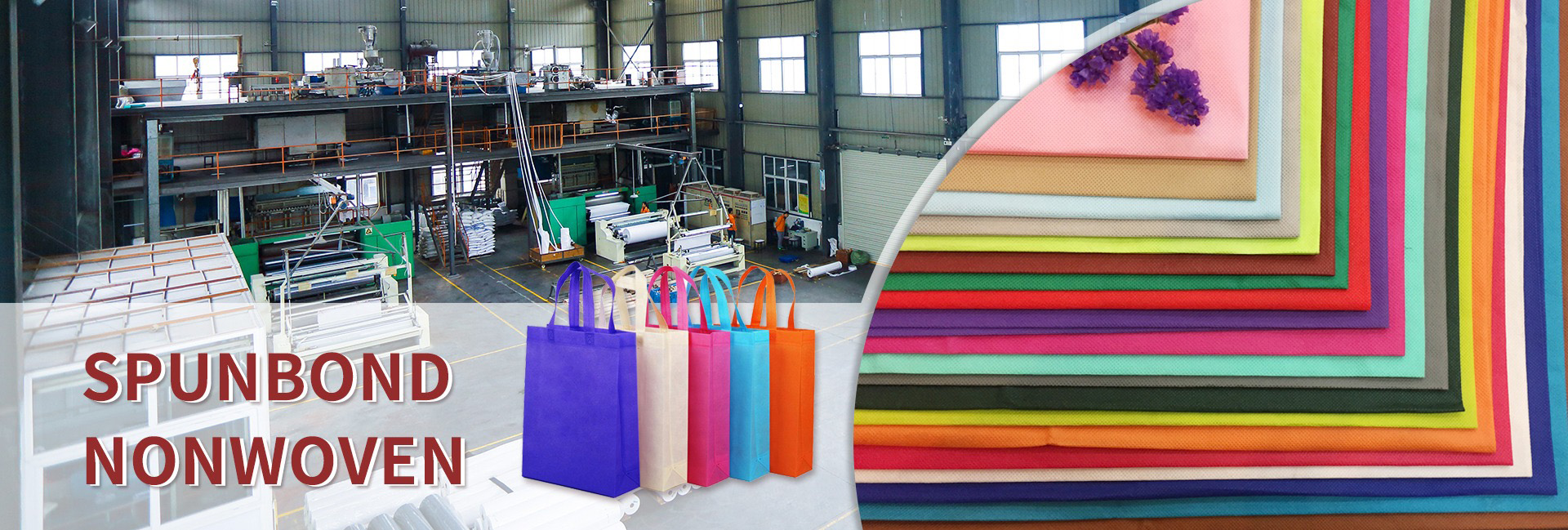
Dongguan Liansheng Non woven Technology Co., Ltd. was established in May 2020. It is a large-scale non-woven fabric production enterprise integrating research and development, production, and sales. It can produce various colors of PP spunbond non-woven fabrics with a width of less than 3.2 meters from 9 grams to 300 grams.
Post time: Dec-13-2025