
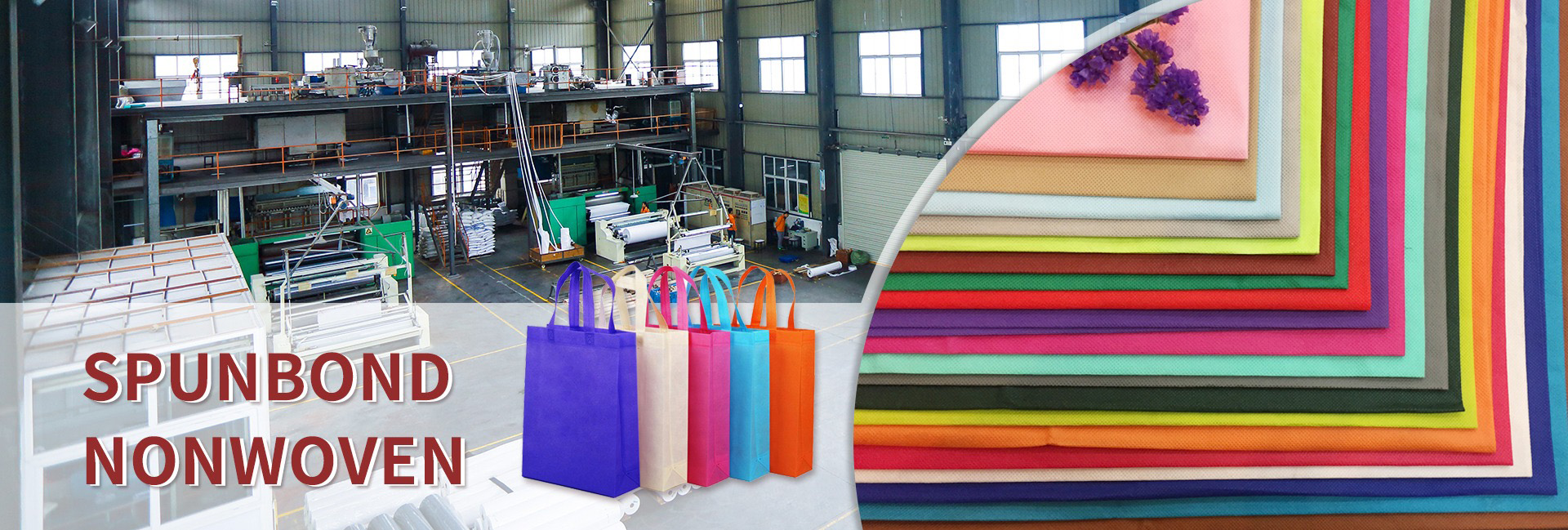
In daily life, the presence of PP non-woven fabric is everywhere: it can be found on the outer protective fabric of masks, disposable face towels, outdoor waterproof and dustproof covers, agricultural grass proof fabrics, and even waterproof bags for express packaging. It is curious that this lightweight, soft, and seemingly “fragile” fabric can withstand immersion in water or rain without rotting, scattering, or fuzzing, and will not easily shatter even when pulled hard.
On the other hand, the toilet paper and napkins we commonly use become soft and crumbly when they come into contact with water, shatter when rubbed, and break when pulled. They are also made of “cloth like” materials, why is there such a big difference? Many people mistakenly believe that PP non-woven fabric does not break when exposed to water because it is thicker than regular paper towels or because the raw materials are more special, but this is not the case.
In fact, the core secret of PP non-woven fabric’s “unbreakable in water” lies not in its thickness, nor entirely in the raw materials themselves, but in its unique production process – fiber thermal bonding technology. Today, we will use plain language to gradually unveil the veil of this technology, understand the underlying logic of PP non-woven fabric’s water resistance, and after reading it, you will understand that its “water resistance toughness” is never accidental.
The core difference between ordinary paper and PP non-woven fabric when encountering water is the “structural difference”
To understand why PP non woven fabric does not break when exposed to water, one must first understand the essential difference between it and regular paper – their molding logic is completely different, which is also the key to their vastly different performance when exposed to water.
Ordinary toilet paper and napkins are mostly made from plant fibers such as wood pulp and bamboo pulp. These plant fibers themselves are hydrophilic, and their production mainly relies on the physical interweaving between fibers, combined with a small amount of wet strength additives, to form a simple “clumping” paper structure. This structure itself is relatively loose. Once it encounters water, water molecules will quickly penetrate into the gaps between fibers, breaking the gripping force between fibers and causing the originally interwoven fibers to instantly loosen and disintegrate. Therefore, when we use paper towels to wipe water, it is easy to cause decay and debris.
PP non-woven fabric, on the other hand, is a completely different set of molding logic. Its raw material is polypropylene (PP) plastic particles, not hydrophilic plant fibers. During production, the plastic particles are melted and drawn to form continuous ultrafine filaments, which are then “glued together” through specific processes to form a cloth like structure. More importantly, it does not require spinning or weaving like traditional fabrics, nor does it rely on additives like ordinary paper. Instead, it relies on thermal bonding technology to truly integrate the fibers, which is also the core foundation of its water resistance.
Simply put, regular paper is a “loose fiber patchwork” that disperses when it comes into contact with water; PP non-woven fabric is a “cured fiber whole” that can maintain structural stability even when exposed to water, which is the most essential difference between the two.
Hot bonding technology, welding each fiber into a whole
The thermal bonding technology of PP non-woven fabric, in layman’s terms, is like welding metal with a soldering iron. Through high temperature and pressure, the intersection nodes of the fibers are melted and bonded, cooled and solidified into a shape. It is equivalent to “spot welding” thousands of ultrafine fibers at each intersection point to form a tight “fiber solidification network”. This process is mainly divided into two key steps, and even one step less cannot achieve the effect of “not breaking when encountering water”.
The first step is to prevent the raw material from softening when exposed to water due to its hydrophobic properties. Polypropylene (PP) is a typical non-polar hydrophobic material that is inherently non hydrophilic and non absorbent. This means that when water comes into contact with the surface of PP non-woven fabric, only water droplets will form and slide off, without penetrating into the inside of the fibers – unlike plant fibers, which soften and expand upon contact with water, fundamentally avoiding the problem of fibers becoming loose and disintegrating due to water absorption.
The second step is high-temperature hot rolling to achieve “body fusion” of fiber nodes. In the production process of PP non-woven fabric, the ultra-fine PP filament after spinning and forming will first be randomly laid into a fluffy fiber web. At this time, the strength of the fiber web is extremely low, and it will spread apart with a light tug. Subsequently, this fiber web will be fed into a hot rolling mill, where under high temperature of 150-160 ℃ and certain pressure, the nodes where the fibers intersect will undergo local micro melting.
At this point, two adjacent PP fibers will adhere to each other in a molten state, and after cooling and solidification, these intersecting nodes will form a firm “bonding point”. On a PP non-woven fabric, there are thousands of adhesive points that firmly fix all dispersed fibers together, making the entire fabric a complete and tight whole instead of a loose fiber pile.
More importantly, this thermal bonding is a ‘body fusion’ process that does not require the addition of any chemical glue or adhesive. However, many ordinary non-woven fabrics rely on chemical adhesives to bond fibers. Once they come into contact with water, the adhesive will dissolve and become ineffective, resulting in non-woven fabric delamination, shedding, and damage; The bonding point of thermal bonding of PP non-woven fabric is itself a part of PP fibers, which will not dissolve or fall off when exposed to water, naturally maintaining structural stability and achieving non breakage when exposed to water.
Thermal bonding technology brings 3 major hardcore advantages to PP non-woven fabric
Fiber thermal bonding technology not only enables PP non-woven fabric to achieve “water resistance”, but also gives it many advantages that other fabrics cannot replace, making it widely used in various fields and an indispensable material in our lives.
The first advantage is high wet strength. After soaking in water, PP non-woven fabric can still maintain good tensile strength and toughness, even if stretched or rubbed hard, it will not tear or break. This feature makes it very suitable for medical protection (such as mask outer layer, protective clothing), wet wipe substrate, waterproof packaging and other scenarios. Even if it comes into contact with water, it can maintain its protective performance and use effect.
The second advantage is corrosion resistance and mold resistance. PP plastic fiber itself has good corrosion resistance, not corroded by water, acidic and alkaline substances, and not decomposed by mold. Therefore, PP non-woven fabric can be used for outdoor agricultural covering, geotextile and other scenarios – even if buried underground or exposed to humid environments for a long time, it can maintain structural stability, not rot or damage, and its service life far exceeds that of ordinary fabrics.
The third advantage is that the structure is stable and not easily deformed. After thermal bonding, PP non-woven fabric has a very tight structure, and there will be no shrinkage or looseness after washing or pouring. It will not produce fluff or chips, and it is clean and durable to use. In contrast, many hydroentangled non-woven fabrics and needle punched non-woven fabrics are prone to deformation and shedding when exposed to water due to the lack of thermal bonding, resulting in a significant decrease in strength.
Not all non-woven fabrics can be “water resistant”
Many people mistakenly believe that all non-woven fabrics can withstand water without breaking, but this is actually a common misconception. Only PP non-woven fabrics produced using “spunbond hot rolling and bonding technology” have such water resistance characteristics; Other types of non-woven fabrics may still experience damage and deformation when exposed to water.
For example, hydroentangled non-woven fabric is formed by mechanically winding fibers together under high-pressure water flow, without thermal bonding. The adhesion between fibers is weak, and it is prone to loosening, deformation, and shedding when exposed to water. It is commonly used in disposable face towels (non waterproof), wet wipes, and inner layers; Some chemical fiber needle punched non-woven fabrics have a relatively loose structure, and their strength will significantly decrease when they come into contact with water, making it impossible to prevent them from breaking when exposed to water.
Simple differentiation method: Rub the non-woven fabric by hand, then sprinkle a small amount of water. If it is not loose, does not fall off, and does not break when pulled hard, it is likely to be PP spunbond hot bonded non-woven fabric; If it becomes soft and sheds fibers when it comes into contact with water, it is another type of non-woven fabric.
PP non-woven fabric “does not break when exposed to water” is essentially a technological victory
By now, I believe everyone has understood that the reason why PP non-woven fabric can achieve non breakage and non rotting when soaked in water is mainly due to two key points: firstly, polypropylene raw materials are naturally hydrophobic, non absorbent, and non softening, avoiding the problem of looseness when exposed to water from the root; The second is to rely on fiber thermal bonding technology to fuse dispersed PP filaments into a solid structure at cross nodes, without the need for glue or weaving, and to achieve “water resistance and toughness” through industrial technology.
From inconspicuous polypropylene particles to melt drawing, heat bonding molding, and becoming an indispensable water-resistant material in our lives, the “water resistance” of PP non-woven fabric is never accidental, but a clever application of industrial technology. It is this seemingly simple thermal bonding technology that has enabled PP non-woven fabrics to overcome the weakness of ordinary fabrics that “rots when exposed to water”, and play an irreplaceable role in various fields such as healthcare, agriculture, home furnishings, and packaging.
Next time you use PP non-woven fabric products, you may want to pay more attention – behind this lightweight and soft fabric, there is a secret of thermal bonding that makes it “unbreakable when exposed to water”, which is also the wisdom of industrial production.
Dongguan Liansheng Non woven Technology Co., Ltd. was established in May 2020. It is a large-scale non-woven fabric production enterprise integrating research and development, production, and sales. It can produce various colors of PP spunbond non-woven fabrics with a width of less than 3.2 meters from 9 grams to 300 grams.
Post time: May-15-2026